11 Dear friends, you are like foreigners and strangers in this world. I beg you to avoid the evil things your bodies want to do that fight against your soul.
12 People who do not believe are living all around you and might say that you are doing wrong. Live such good lives that they will see the good things you do and will give glory to God on the day when Christ comes again. (1 Peter 2:11-12 NCV)
In his first letter, the apostle Peter is encouraging new believers of five first century churches located in Roman cities in Asia Minor. The audience is believed to be a mixture of Jewish Christians who were exiled from Rome and Gentiles living in their hometown, who have come to faith. Either way, what used to be normal in their past lives is now foreign. Serving the risen Christ who was crucified for all sins, there was no longer a need for idol worship and animal sacrifices in a temple.
The early Christians no longer fit in and were socially ostracized. Their new identity was in Christ, not in the world. Because of this they were being persecuted for their faith. Peter reminds them that Christ, who suffered and returned to glory, would also give glory to those who remained faithful.
Today I received the 2nd shot of the Moderna COVID 19 vaccine. A year ago this month, the pandemic became a reality for me and my family. Schools quickly changed from in-person to virtual learning. Now I have returned to tutoring and substitute teaching and I feel grateful that K-12 personnel are included in phase 1b in my state.
As I think about how viruses gain entry to the human body and how vaccines work, the term that comes to my mind is identity. God created each person with their own identity which is governed by the immune system. Anything that enters the body and is not identified as “self” can cause an allergic reaction, an immune response. This can be as simple as a piece of dust, pet dander, pollen, or as deadly as venom from a black widow spider or a copperhead snake.
But how can something as simple and microscopic as a virus cause an immune response? The SARS-CoV-2 virus responsible for the COVID-19 pandemic is made up of two major components, a protein coat with attachment spikes and single-stranded RNA that codes for its production. Yes, viruses are so simple that they cannot even reproduce on their own. But that doesn’t stop viruses from invading the human body with a deadly disease.
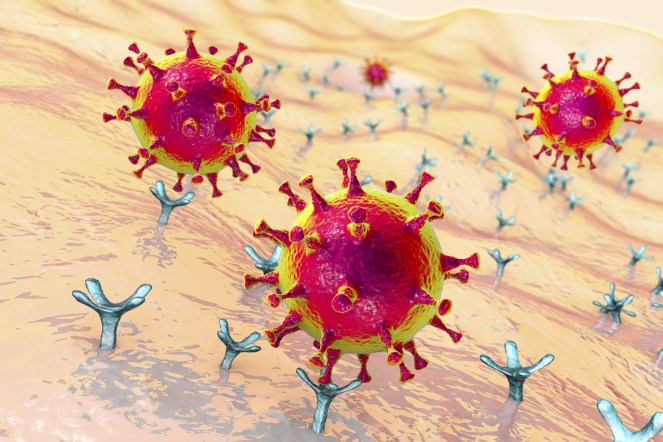
When the SARS-CoV-2 virus enters the respiratory system, it identifies cells in the lining of the nasal passages that have a specific receptor. The virus protein spikes attach to the receptors. The protein coat remains outside the cell, it has performed its job.
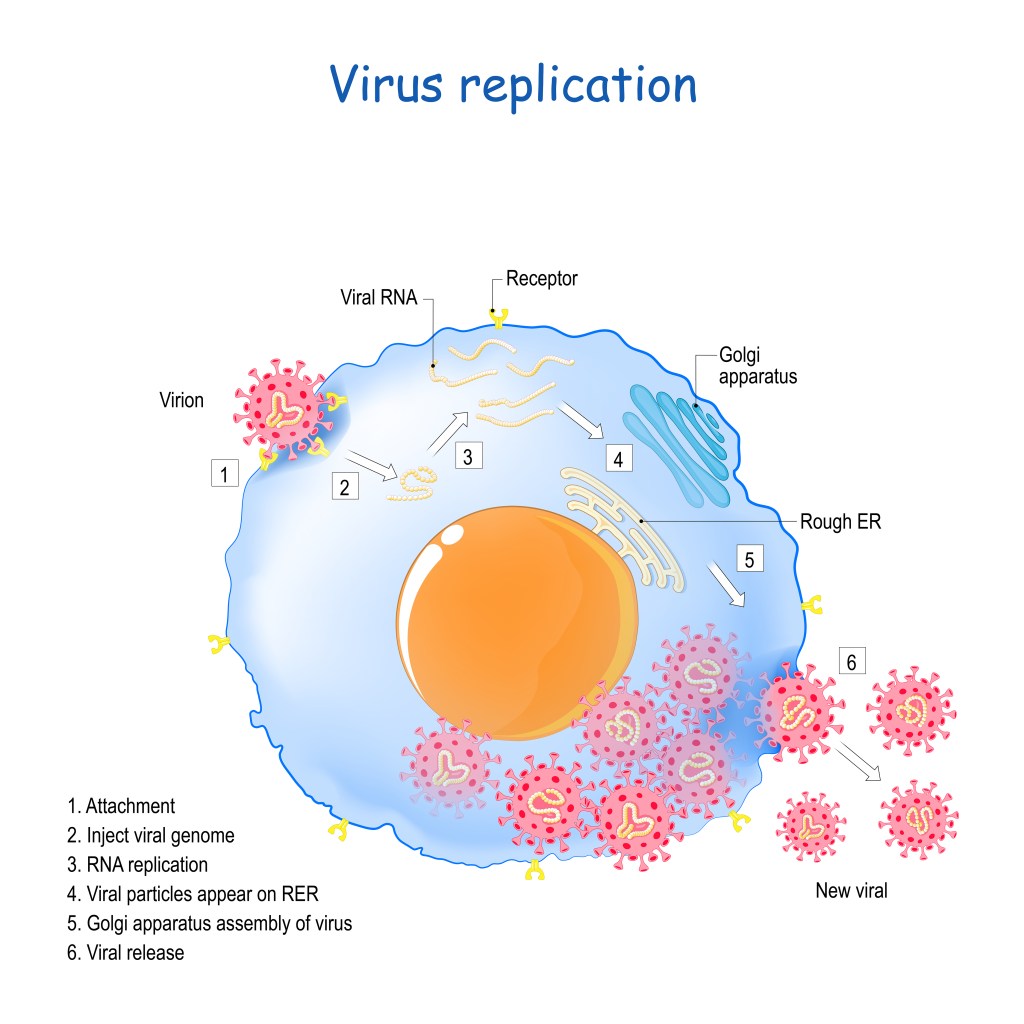
The RNA strand is injected into the cell, hijacking it to produce multiple protein coats and RNA strands. These components are assembled into a multitude of new viruses which burst out of the infected cell, often killing it.
As the virus multiplies, an infected person may shed copious amounts of it, especially during the first week or so. Symptoms may be absent at this point. Or the virus’ new victim may develop a fever, dry cough, sore throat, loss of smell and taste, or head and body aches.
Each new virus seeks out another cell with the surface receptor along the respiratory tract to invade. The further down the respiratory tract the viruses invade, the more numerous these surface receptors are located and the more deadly the invasion becomes. The thinner, distant branches of the bronchioles in the lungs end in tiny air sacs called alveoli. Each air sac is lined by a single layer of cells that are rich in the cell surface receptor. The function of the surface receptor is to help regulate blood pressure, which is crucial for oxygen to enter the blood.
When the SARS-CoV-2 virus enters the body, it is immediately recognized as foreign. The immune system starts producing antibodies to destroy it. Scientists are studying how long a COVID-19 survivor may be protected by the memory cells that exist from their illness.

The Moderna vaccine works by the same process of immune response as the virus itself. The vaccine contains a segment of the messenger (mRNA) from the SARS-CoV-2 virus. The mRNA enters a cell and hijacks it to produce pieces of the spike protein. The body identifies these spike proteins as foreign and initiates an immune response. Antibodies are produced which will destroy the SARS-CoV-2 virus and remain as memory cells to hopefully protect against future attacks.
Since the SARS-Co -2 is a novel virus, scientists will continue research the vaccine’s efficiency on new variants. Viruses are highly prone to mutation because their genome is so small that any error that occurs during replication of the RNA can result in a structural change in the protein spikes. Will the antibodies produced by the vaccine recognize the identity of the new variants? Will the vaccine need to be modified? Will a booster shot need to be added to those people who have been vaccinated?
To those first-century Christians, the Holy Spirit was like the ultimate immune system. Unlike those of us who seek vaccines to fight viruses, those believers who found a new identity in Christ had the Holy Spirit to help them fight off the “evil things” their bodies wanted them to do. Not only were they being attacked by their own desires, but by the society around them that accused them of “doing wrong.” Every fresh accusation, whether from within or without, was like a new variant, seeking to wage war on their new identities.
No one yet knows just how effective the new vaccines will be against COVID-19 variants, nor are they certain how long bodies who have defeated the virus will retain the memory needed to block new infection. However, as followers of Jesus, we can stand with those early churches in faith that Christ will give us the strength we need to withstand attacks of every kind. As we continue to look to Him and draw from His power, we have access to a hope that can do some “infecting” of its own.
This Sunday, Christians all over the world will worship a risen Savior, Jesus Christ. Just as Peter encouraged the churches to “always be prepared to give an answer to everyone who asks you to give the reason for the hope that you have, but do this with gentleness and respect” (1 Peter 3:15), we are reminded to do the same. As we stand and ward off the destructive infection of sin, the world is watching. It could be that someone in our lives is now in darkness, seeking a way out. Let us pray that we will have the grace this Easter to spread the infectious love and hope of Christ to those who need it most.
SARS CoV binding to ACE receptors Illustration 178593136 © Katerynakon | Dreamstime.com
MRNA Schematic Illustration 208449737 © Alexander Kovalenko | Dreamstime.com
Coronavirus replication Illustration 177685518 © Designua | Dreamstime.com

 Fearfully and Wonderfully Made
What an awesome analogy! Thank you, Peggy!
LikeLike
Thank you Sue for your encouragement! Happy Easter!
LikeLike