13 The blood of goats and bulls and the ashes of a heifer sprinkled on those who are ceremonially unclean sanctify them so that they are outwardly clean.
14How much more, then, will the blood of Christ, who through the eternal Spirit offered himself unblemished to God, cleanse our consciences from acts that lead to death, so that we may serve the living God! (Hebrews (9: 13-14 NIV)
The author of Hebrews seeks to reassure persecuted Jewish Christians that Christ, not the Old Testament Law, is God’s ultimate plan for their salvation. Even in their discouragement, the author admonishes them to avoid the temptation of returning to empty practices and ceremonial rituals to please God.
The author affirms that Christ’s sacrifice is superior to the use of animal sacrifices of the old covenant. The priests had to continually offer sacrifices, not only for the sins of the people, but also for their own sins. Ultimately, the death of an animal could only serve to alleviate the feeling of guilt and the fulfillment of the law. The blood of animals alone could not bring about a transformation within a person.
In contrast, Christ’s sacrifice was perfect and sinless. His death on the cross secured an eternal redemption for the sins of all people. In Hebrews chapter 9 verse 14, the author accentuates the importance of Christ’s sacrifice, “How much more then will the blood of Christ, who through the eternal Spirit offered himself without blemish to God, cleanse our consciences from the acts that lead to death, so that we may serve the living God!”
Blood also plays a critical role in the functioning of the human body. Homeostasis is a term used to describe the functions of your body which work to keep your internal environment constant within a very narrow range. Basically, when it comes to normal concentration, volume, and chemical makeup of bodily fluids like water and blood, change is unhealthy for the human body. One organ that plays a key role in maintaining homeostasis within your body is the kidney.
The nephron is the functional structure within your kidney that produces urine in the process of removing waste and excess substances from the blood. There are about 1,000,000 nephrons in each human kidney. The kidneys produce urine which is made up of waste products, excess mineral ions and excess water from the body. The main job of the kidneys is to regulate the amount of water in the body and balance the concentration of mineral ions in the blood. They also get rid of waste products. At the same time, they hold on to useful substances.
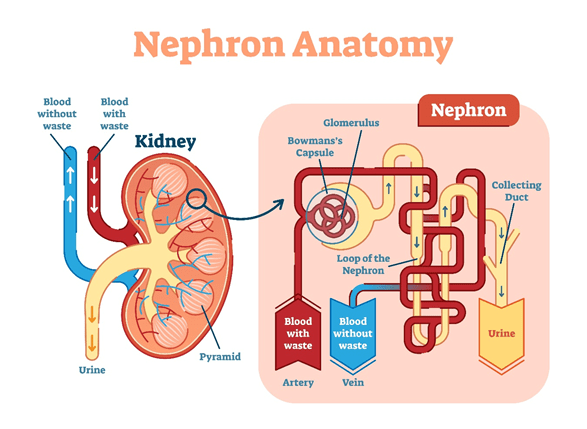
As the blood with wastes enters the nephron it is filtered in the semipermeable glomerulus. Red blood cells and larger proteins are too large to pass into Bowman’s capsule. Ions, such as sodium, potassium and calcium, and water, glucose and amino acids, the building blocks of proteins are small enough to pass through. They form a mixture, called the filtrate. Upon exiting the glomerulus, the filtrate enters the tube where important nutrients such as glucose, amino acids, and vitamins are reabsorbed. These nutrients return to the blood, traveling to where they are needed.
As the filtrate continues traveling down the loop of the tube, and then back up, the concentration of water and salts is adjusted to maintain healthy blood volume. Different parts of the loop are permeable to either salt or water, ensuring that the correct amount of water and salt will be returned to the blood. Wastes and excess water and salt leave the nephron in a mixture called urine. Multiple nephrons empty their urine into collecting ducts which merge at the renal pelvis and then into the ureter. Each kidney has its own ureter which transports the urine from the kidney to the urinary bladder for storage until it is eliminated from the body.
I have only touched the surface of this amazing organ, the kidney. Not only does the design of the nephron’s glomerulus prevent the loss of red blood cells, but when special cells in the kidney detect low oxygen levels in the blood, they produce and release the hormone that travels to the bone marrow, stimulating the production of new red blood cells. And the intimate weaving of the capillaries around the tube facilitates the back-and-forth exchange of water and salt to ensure that blood leaving the kidney and returning to circulation, is not too thin, not too thick, but just right!
Just think about all the intricate processes that keep our blood pure and clean, and then think about God’s gift to us that keeps our hearts pure and clean! Christ’s sacrifice on the cross is more than an outward display of love; His blood shed for us ensures that we experience a deep, lasting inward change. While homeostasis keeps the good things in balance and eliminates the bad elements in our bodies, the author of Hebrews proposes that we also keep a similar kind of homeostasis in our spiritual walk. Thankfully, unlike the kidneys which are responsible for a deep and thorough cleansing of our blood, God’s grace is freely given to us to help us rid ourselves of anything impure or damaging to our spiritual walk with Him. Titus 2:14 reminds us that it is “…our great God and Savior, Jesus Christ, who gave himself for us to redeem us from all wickedness and to purify for himself a people that are his very own, eager to do what is good.”
If you are someone who continues to live under the weight of a guilty conscience, or if you face discouragement because you just can’t seem to redeem yourself, remember that forgiveness and purification aren’t really up to you at all. Leave the workings of your body to your kidneys and leave the workings of your heart to God.
He forgives.
He purifies.
He heals.
Keep seeking Him, and He will make you clean!
Illustration 108044141 / Nephron © VectorMine | Dreamstime.com

 Fearfully and Wonderfully Made