4I sought the Lord, and he answered me;
he delivered me from all my fears.
5 Those who look to him are radiant;
their faces are never covered with shame.
6 This poor man called, and the Lord heard him;
he saved him out of all his troubles.
7 The angel of the Lord encamps around those who fear him,
and he delivers them. (Psalm 34: 4-7 NIV)
Let us look at the ways the word “fear” is used in this passage of Scripture. In verse 4, the Hebrew word for fear is translated as “fear for fear’s sake,” or “human fear.” David, the author of this psalm, is fearful for his life. He is fleeing from his enemies and cries out to the Lord. The Lord heard David’s cries and delivered him from his enemies and his fears.
In verse 7, the Hebrew word for fear is used as in “those who fear the Lord.” It is much more about having a “holy reverence” for the Lord, not so much fear in a scary sense. The Lord delivers those who have a holy reverence or awe of Him.
In anatomical terms, human beings are created with a specific response to fear: they either try to defend themselves or try to escape when they are scared or in danger. This response controlled by the sympathetic nervous system is commonly known as “fight or flight” by a person who is in these situations.
The sympathetic nervous system is one of the three branches of the autonomic nervous system. The autonomic nervous system, as its name implies, automatically regulates involuntary physiologic processes. Examples of involuntary physiologic process are heart rate, blood pressure, respiration and digestion. Even though a person can increase or decrease the normal activity of these processes, the autonomic nervous system activates and maintains them. For example, the heart beats, the lungs respire, and the stomach digests without a person even thinking about it, none the less being in charge of them.
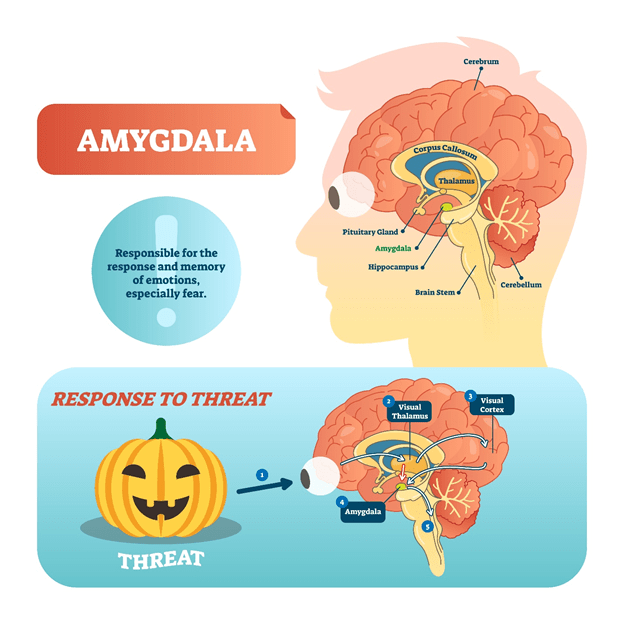
The sympathetic nervous system is fearfully (there’s that word “fear” again!) and wonderfully designed. Refer to the picture below to see the coordination among the eye, the visual thalamus, the visual cortex, the amygdala, and the sympathetic nerves which originate inside the vertebral column.
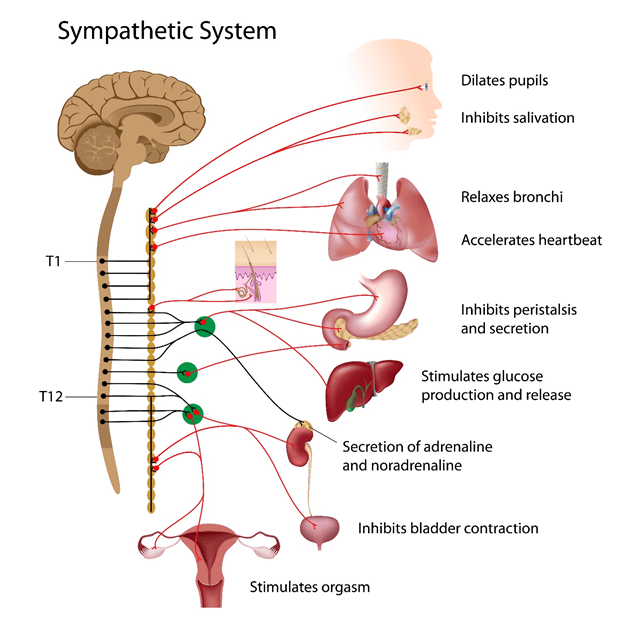
Refer to the picture below to see the location of the sympathetic nerves and which organs they control. The pupils of the eyes dilate, allowing more light to enter the eye, increasing vision. The bronchi of the lungs relax and widen, increasing airflow and respiration rate. The pacemaker of the heart increases heart rate, sending extra blood to the muscles. These and other physiological changes enable the body to respond to a fearful or dangerous situation.
God has perfectly designed our bodies to handle both the kind of fear that David faced when running away from his enemies, as well as the fear, reverence, David felt when praying to the God who delivered him. We are given the tools to either stand up to, or escape danger as well as the awareness of something greater than ourselves, our God, whom we worship in holy reverence or awe.
The following verses below remind us that not only does God help us overcome our earthly fears, but that when we fear God, our relationship with Him deepens and our knowledge of Him increases. We discover the abundant life that God created for us.
For God has not given us a spirit of fear, but of power and of love and of a sound mind. (2 Timothy 1:7 NKJ)
The fear of the LORD is the beginning of knowledge. (Prov. 1:7a NIV)
For I, the LORD your God, will hold your right hand,
Saying to you, “Fear not, I will help you.” (Isaiah 41:10 NKJ)
ID 25474175 © Alila07 | Dreamstime.com sympathetic nervous system
ID 125279049 / Amygdala © VectorMine | Dreamstime.com

 Fearfully and Wonderfully Made
Awesome. Thanks
Sent from Yahoo Mail on Android
LikeLike
Thanks, Peggy —this is a great devotional about types of fear. Blessings, Joyce
LikeLike