8-12 There were shepherds camping in the neighborhood. They had set night watches over their sheep. Suddenly, God’s angel stood among them and God’s glory blazed around them. They were terrified. The angel said, “Don’t be afraid. I’m here to announce a great and joyful event that is meant for everybody, worldwide: A Savior has just been born in David’s town, a Savior who is Messiah and Master. This is what you’re to look for: a baby wrapped in a blanket and lying in a manger.”
13-14 At once the angel was joined by a huge angelic choir singing God’s praises:
Glory to God in the heavenly heights,
Peace to all men and women on earth who please him. (Luke 2:8-14 MSG)
What is your favorite Christmas song? For me it is the song “Joy to the World.” From my earliest memories I have always loved attending the Christmas Eve service. When I enter the church there is a sense of expectation in the air. At the end of the service, it is often a tradition to dim the lights in the sanctuary. Then, during the opening verses of “Joy to the World,” everyone passes their lit candle down the row and lights the candle of the person seated next to them. The sight of darkness being broken by the light of the hundreds of candles always makes me feel a sense of awe. And then the darkness is further pierced when we raise our lit candles in praise and worship during the final verse of the song. When the song is finished, we blow out our candles and exit the sanctuary to the sound of the organ belting out “The Hallelujah Chorus.” To this day, as I leave the church after that service, I have an overwhelming sense of joy.
In the verses from Luke above, an angelic choir sings God’s praises. But angels aren’t the only ones with this heavenly opportunity! God created us to sing, too. Yes, I know. Some of you are laughing to yourself as you think, “Um…you’ve never heard me try to sing! Why can’t I sing (or at least sing well)??” I’ll discuss some possible reasons after I describe the anatomy of the larynx, more commonly called the voice box.
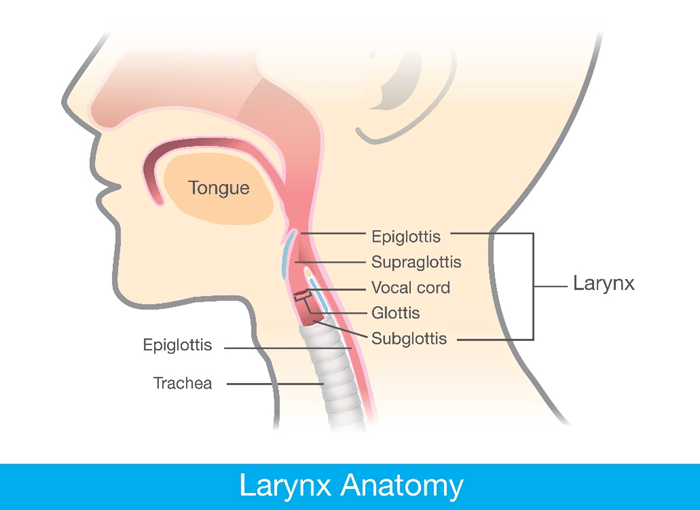
The larynx is located in the perfect position to be protected by the epiglottis and to receive delivery of air from the lungs through the trachea. When a person swallows, the epiglottis, a flexible flap, closes the airway so that food and other substances enter the digestive system through the esophagus. The epiglottis consists of flexible cartilage which maintains the structure of the epiglottis while allowing flexibility. The vocal cords are located within the larynx.
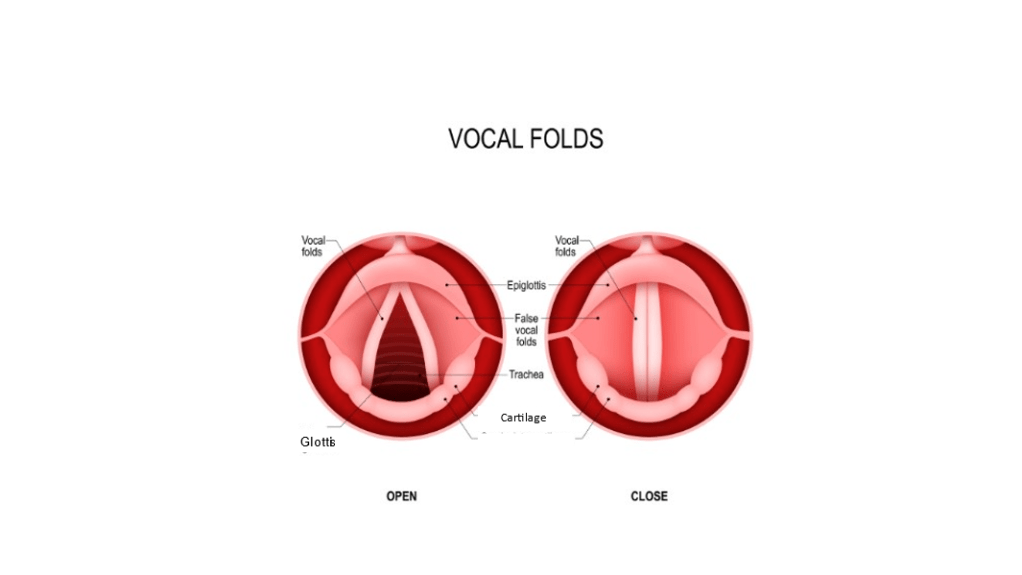
The vocal folds – more commonly called the vocal cords – are supported by both hyaline cartilage for attachment to the trachea, and flexible cartilage that allows the vocal cords to open and close. The vibration of the vocal cords produce sound.
When a boy reaches puberty, his body begins making lots of testosterone, causing his larynx to grow. Not only do older boys and men sound different from boys, you can also see the difference in their necks. As the larynx increases in size the front of the thyroid cartilage that surrounds the larynx tends to protrude outward, creating a feature known as the “Adam’s apple.” You can see it at the front of the throat.
Another change that occurs is the boy’s vocal cords become thicker and longer to accommodate the increased size of the larynx. Vocal cords are thin muscles that stretch across the larynx like rubber bands. Think about the strings on a guitar. Which ones produce lower notes? The thicker the strings, the lower the sound because thick strings vibrate slower than thin strings.
These muscles are not located outside the vocal cords like skeletal muscles that are attached to bones. They are intrinsic muscles, actually located within the vocal cords. They cannot be directly controlled like the bicep muscle that is attached to the upper arm bone (humerus) being exercised during weightlifting in a gym. Training the muscles of the vocal cords requires coordination with muscles of the jaw, tongue, neck and pharynx. Warmups and exercises can be designedto target specific muscle groups. In addition, training of the large dome-shaped diaphragm muscle located beneath the lungs increases its control of the air supply to the vocal cords. Have you ever asked yourself, “How can that singer hold notes for so long?” It appears effortless.
However, if you ask any professional singer, they will tell you that singing is an athletic event. It requires discipline and training. Which gets us back to the discussion of why some people cannot sing accurately. It may be because they don’t have good control of their vocal muscles. Or they may not be able to hear differences in pitch or discriminate between two different sounds. And to be sure, some aspects of singing are influenced by genetics. IF you are one of these people, do not give up! You will be surprised what voice training can do. However, if perhaps you have not the time nor the desire to embark on such an endeavor, remember this: God loves even a joyful noise. If a horse can whinny and a pig can squeal in delight, surely your praise – no matter how it sounds – reaches His ears!
My prayer for you and your family this Christmas season is that you will experience peace, love, and Jesus Himself. Just over 2,000 years ago in a tiny manger in Bethlehem, Jesus entered the world to give mankind its greatest gift. Rejoice and receive your King!
Joy to the world! The Lord is come
Let earth receive her King!
Let every heart prepare Him room
And heaven and nature sing
And heaven and nature sing
And heaven, and heaven and nature sing.
Illustration 71512582 © Suriya Siritam | Dreamstime.com
Illustration 117475628 © Designua | Dreamstime.com

 Fearfully and Wonderfully Made