19 On the evening of that first day of the week, when the disciples were together, with the doors locked for fear of the Jewish leaders, Jesus came and stood among them and said, “Peace be with you!” 20 After he said this, he showed them his hands and side. The disciples were overjoyed when they saw the Lord. (John 20:19-20 NIV)
Have you ever wondered why the glorified body of the resurrected Jesus still had the scars from his crucifixion? Why didn’t God heal the scars?
God left the scars as a reminder to us that Jesus suffered on the Cross to pay for our sins. Throughout eternity the Church of Jesus will look on those scars in Christ’s body and give grateful worship for what he has done for us. But there is more. Jesus anticipates that we will have scars, too. When the risen Christ sent his disciples into the world to share the Gospel with others, he gave them an unforgettable visual object lesson.1
21 Again Jesus said, “Peace be with you! As the Father has sent me, I am sending you.” (John 20:21 NIV)
In the following Scripture, the apostle Paul is addressing the Christians in Galatia. They are debating on whether Gentiles who are now followers of Christ need to be circumcised. According to Jewish law, circumcision, performed on the eighth day of birth, is the physical representation of the covenant between God and Abraham. This debate was one of many that occurred in the early church, which was made up of both converted Jews and Gentiles. What religious and cultural rituals needed to remain?
Paul had many scars from the stonings and beatings he received during his ministry when he was persecuted for his faith. There was no need to cover them up – they were a sign of his relationship with Jesus. He wrote:
14 As for me, may I never boast about anything except the cross of our Lord Jesus Christ. Because of that cross, my interest in this world has been crucified, and the world’s interest in me has also died. 15 It doesn’t matter whether we have been circumcised or not. What counts is whether we have been transformed into a new creation. 16 May God’s peace and mercy be upon all who live by this principle; they are the new people of God.
17 From now on, don’t let anyone trouble me with these things. For I bear on my body the scars that show I belong to Jesus. (Galatians 6:14-17 NLT)
Do you have a scar? If so, you can probably tell the story of what happened to produce the scar. I have a scar above my right eye named “Goofy!” I fell at Disney’s Animal Kingdom Theme Park in Orlando, Florida. When I hit the ground, my eyeglasses broke, and a jagged piece of glass ripped into my eyelid. I’m thankful that stiches closed the wound and my eye received no damage.
Scars from knee replacement surgery are common in older people whereas scars from ACL (anterior cruciate ligament) surgery are common in youth and young adult athletes. Some people treat the scar to lessen its appearance; others leave it as-is. India includes a visible identification mark on its visa applications and applicants often make note of their scars.
If human skin regenerates itself approximately every 30-40 days, why doesn’t a scar disappear? Because it’s not true that all your skin cells replace themselves periodically. Only the epidermal cells do; they live 30–40 days and flake off from the surface. But your skin consists of epidermis and dermis, and scars consist of dense fibrous tissue in the dermis.
This shows the two components of the skin. In this particular photo, all of that dermis is scar tissue; it wouldn’t look this dense if it were undamaged dermis. (Compare this photo to the following photo of normal skin.)The only cells that you shed periodically are the ones in the epidermis. The loose fibrous matter at the very top is composed of dead epidermal cells on their way to flaking off.
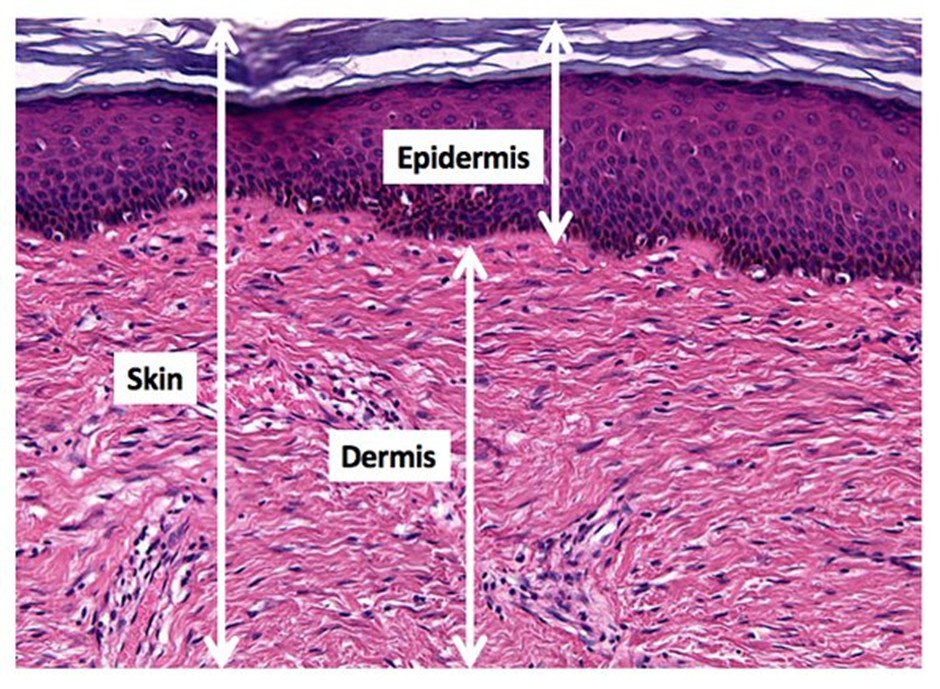
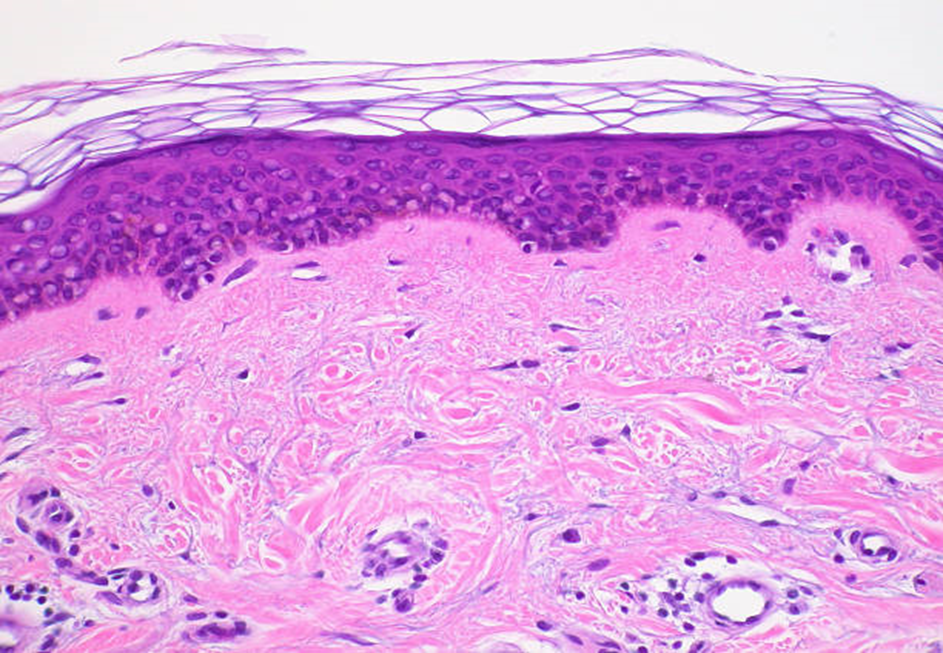
What causes the dermis to become denser at the site of a scar? When an injury occurs in the dermal layer, the skin forms new collagen fibers to mend the damage, resulting in a scar. Collagen is a natural protein in the skin. However, the overproduction of collagen during the healing of the wound blocks regeneration of normal tissue. This process results in new scar tissue that has a different texture, color and quality than the surrounding tissue. A hypertrophic scar is a thick raised scar that forms from burns or surgical incisions in taut skin. An atrophic scar is an indented or sunken scar that heals below the normal layer of skin tissue because the skin is unable to regenerate tissue.
No matter what type of scar, it’s the natural way that human skin is able to heal wounds. Scars are rarely aesthetic. Even the word “scar” has a negative connotation. One of Disney’s most famous villains is the lion Scar in the movie, The Lion King. But scars serve a life-protecting purpose by closing open wounds; remember that the skin is the first line of defense against foreign invaders that cause disease.
If the skin is our first line of defense against physical disease, God remains our first line of defense in any spiritual attack. Just as we do not emerge from injury without a scar, the war Jesus fought against sin and death left marks of its own. In choosing to leave the scars, God reminds us that Jesus fought, continues to fight, and always wins.
But His fight came with a cost.
In closing, reread the two scriptures for this devotional, John 20:19-21 and Galatians 6:14-17. Then listen to Michael Card sing “He Will be Known by His Scars.” I pray that the Holy Spirit will bless you and give you hope knowing how much Jesus loves you. He gave His life so that you can live a victorious life here on Earth and spend eternity with Him.
https://www.microscopyu.com/gallery-images/scar-tissue-at-10x-magnification-1
1Key, Stan. Face to Face. (The Francis Asbury Society, 2015), 218.

 Fearfully and Wonderfully Made