The Holy Spirit Comes at Pentecost
2 When the day of Pentecost came, they were all together in one place. 2 Suddenly a sound like the blowing of a violent wind came from heaven and filled the whole house where they were sitting. 3 They saw what seemed to be tongues of fire that separated and came to rest on each of them. 4 All of them were filled with the Holy Spirit and began to speak in other tonguesas the Spirit enabled them.
5 Now there were staying in Jerusalem God-fearing Jews from every nation under heaven. 6 When they heard this sound, a crowd came together in bewilderment, because each one heard their own language being spoken. 7 Utterly amazed, they asked: “Aren’t all these who are speaking Galileans? 8 Then how is it that each of us hears them in our native language? 9 Parthians, Medes, and Elamites; residents of Mesopotamia, Judea and Cappadocia, Pontus and Asia, 10 Phrygia and Pamphylia, Egypt and the parts of Libya near Cyrene; visitors from Rome 11 (both Jews and converts to Judaism); Cretans and Arabs—we hear them declaring the wonders of God in our own tongues!” (Acts 2:1-11, NIV)
Have you ever heard the idiom, “native tongue?” In verse eight you read, “native language” and in verse eleven you read, “own tongues.” Well, “native tongue” is an idiom that means a person’s first language.
God created the tongue to perform many functions. The tongue aids in chewing, swallowing, tasting, and the formation of sounds and speech. In this devotional, I am focusing on the importance of the tongue in language formation.
In high school, I studied Latin. At the time, I did not know how important the knowledge of the Latin language would help me in my future career. I am a retired high school Science teacher and for most of my career, I taught Biology, Anatomy, and Physiology. The content in these science courses waschallenging because of the large number of new terms predominately based on the Latin language. Because of my Latin language knowledge, I was able to learn the content for myself and also effectively teach my students. I often used the Latin roots of the biological terms to help my students understand the terms, not just memorize them. For example, the Latin root “arthro,” meaning joint, is used to name the Phylum Arthropoda which includes animals like crickets and lobsters with jointed appendages (legs and antennae.) The root “itis,” meaning inflammation, joins “arthr” to name arthritis, the common medical condition for swollen joints.
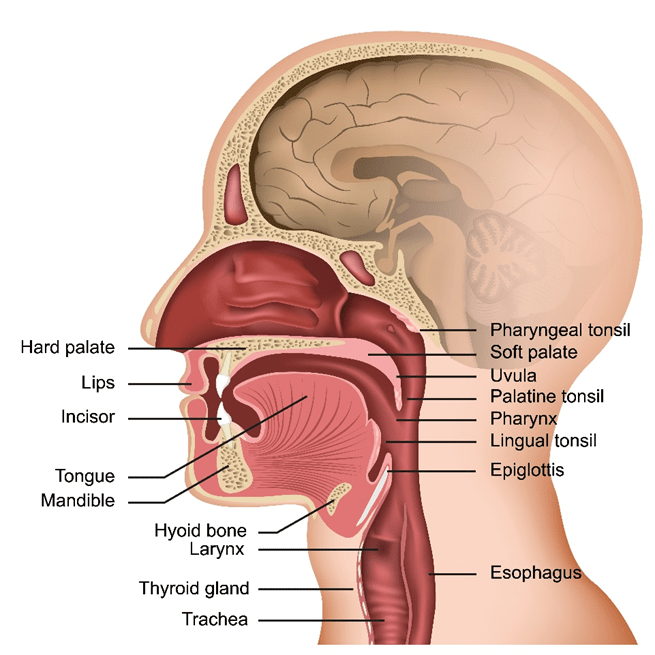
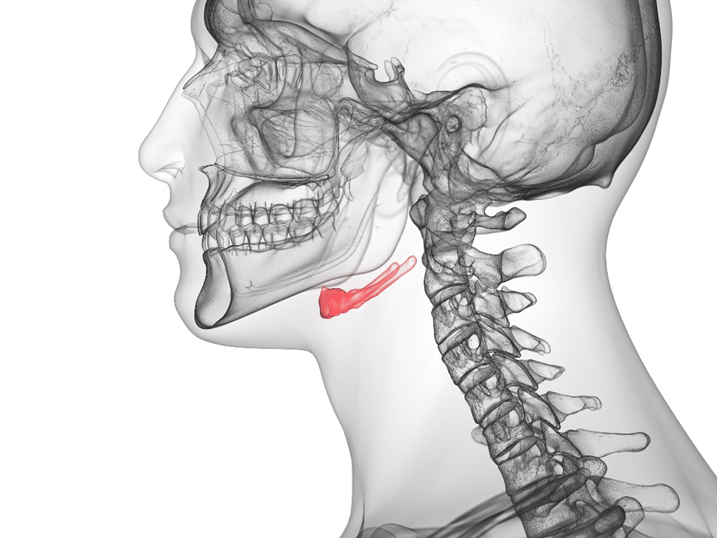
Depending on which language you speak, you use your tongue in different ways to make unique sounds. The tongue is a voluntary muscle, anchored to the mouth by webs of tough tissue and mucosa. The tether holding down the front of the tongue is called the frenum. In the back of the mouth, the tongue is anchored into the hyoid bone. The hyoid bone is located in the front of the neck, just below the lower jaw. It plays a vital role in speech by carrying the weight of the back of thetongue. The hyoid bone is unique in that it is the only bone in humans that does not articulate with any other bone, but only has muscular, ligamentous, and cartilaginous attachments. Given this peculiarity, it has been described as “free-floating.” The hyoid bone is shaded in red in the photo below.
Certain sounds require the assistance of the hard palate and top front teeth in order to be produced correctly. For example, The /th/ sound in the English words “think,” “those,” and “that” requires articulation of the tongue with the front upper teeth. When the tongue passes the upper teeth, there should be space for air to travel between the tongue and the upper teeth. The air that passes between the tongue and upper teeth is what makes the /th/ sound. The tongue barely has contact with the upper teeth, and contact is very light.
If you take the tip of your tongue and stroke the area behind your top teeth and then slide it backwards slowly you should feel a little bumpy ridge. That is the alveolar ridge, located between the front teeth and the hard palate. When producing the sounds of the letters, T, D, N, and L, the tongue articulates with the alveolar ridge. Try this for yourself by saying, “This dog needs a leash.”
If you have ever tried to learn a new language, you know that proper pronunciation can be incredibly difficult. After years (or decades) of using our tongue to make certain sounds, it takes practice (and courage!) to try and train those muscles to work differently. This makes the passage from Acts even more amazing. When I picture this scene in my head, I imagine that the visitors to Jerusalem not only heard the Good News in their own language but that the pronunciation was spot-on!
According to Wycliffe Global Alliance, the Bible in its entirety has been translated in 724languages. The New Testament has been translated into an additional 1,617 languages, and smaller portions of the Bible have been translated into 1,248 other languages. Take a minute and think about how many people have been dedicated to the task of reaching people all over in the world with the Good News!
While missionaries and their interpreters play a vital role in telling the Gospel story to those who speak different languages in other countries, there are often people in your own country who may not share your “native tongue.” Five years ago, I started studying Spanish with my close friend from Colombia as my teacher. At the time, I thought maybe God was preparing me to serve on the mission field in a Spanish-speaking country. But as it turns out, my mission field is right here where I live. This is my third year of tutoring high school Hispanic students in math and science. I am very thankful for the opportunity to help my students be successful in their high school education, and my hope is that they see Christ through me, even as I continue to try and train my tongue to better learn their language.
As with all creation, God formed every part of our bodies to fulfill a special purpose. With our tongue, we have incredible power to bless and curse, hurt or heal. Ultimately, may we live in such a way that – even without words – we urge others on to Paul’s declaration “…that at the name of Jesus, every knee should bow, in heaven and on earth and under the earth, and every tongue confess that Jesus Christ is Lord, to the glory of God the Father.” (Philippians 2:10 -11, ESV).
Illustration 142193269 / Anatomy Tongue © Medical Stocks | Dreamstime.com
Illustration 155218917 / Anatomy © Sebastian Kaulitzki | Dreamstime.com

 Fearfully and Wonderfully Made