Jesus Presented in the Temple
22 When the time came for the purification rites required by the Law of Moses, Joseph and Mary took him to Jerusalem to present him to the Lord 23 (as it is written in the Law of the Lord, “Every firstborn male is to be consecrated to the Lord”), 24 and to offer a sacrifice in keeping with what is said in the Law of the Lord: “a pair of doves or two young pigeons.”
25 Now there was a man in Jerusalem called Simeon, who was righteous and devout. He was waiting for the consolation of Israel, and the Holy Spirit was on him. 26 It had been revealed to him by the Holy Spirit that he would not die before he had seen the Lord’s Messiah. 27 Moved by the Spirit, he went into the temple courts. When the parents brought in the child Jesus to do for him what the custom of the Law required, 28 Simeon took him in his arms and praised God, saying:
29 “Sovereign Lord, as you have promised,
you may now dismiss your servant in peace.
30 For my eyes have seen your salvation,
31 which you have prepared in the sight of all nations:
32 a light for revelation to the Gentiles,
and the glory of your people Israel.”
33 The child’s father and mother marveled at what was said about him. 34 Then Simeon blessed them and said to Mary, his mother: “This child is destined to cause the falling and rising of many in Israel, and to be a sign that will be spoken against, 35 so that the thoughts of many hearts will be revealed. And a sword will pierce your own soul too.”
36 There was also a prophet, Anna, the daughter of Penuel, of the tribe of Asher. She was very old; she had lived with her husband seven years after her marriage, 37 and then was a widow until she was eighty-four. She never left the temple but worshiped night and day, fasting and praying. 38 Coming up to them at that very moment, she gave thanks to God and spoke about the child to all who were looking forward to the redemption of Jerusalem.
39 When Joseph and Mary had done everything required by the Law of the Lord, they returned to Galilee to their own town of Nazareth.
(Luke 2: 22-39, NIV)
Luke portrays Simeon as a devout and righteous man. He read and reflected upon the Old Testament. He was waiting in Jerusalem, longing expectantly for Scripture’s fulfillment found in Isaiah 40, God’s promised salvation as a light for revelation to the Gentiles, and for glory to your people Israel. The Holy Spirit had revealed to Simeon that he would not die before he had seen the Lord’s Messiah. And now the time had come! Simeon took the child Jesus in his arms and praised God, quoting memorized Scripture that comforted him as he waited and trusted in God.
The prophet Anna was also part of the celebration. She never left the temple, but worshiped night and day, fasting and praying. Recognizing the Christ child, she came up to him and praised God, proclaiming to all who had waited 400 years for the Messiah that their waiting was over.
Last month you learned about how scents are transported and detected by your brain. Here is a brief summary.
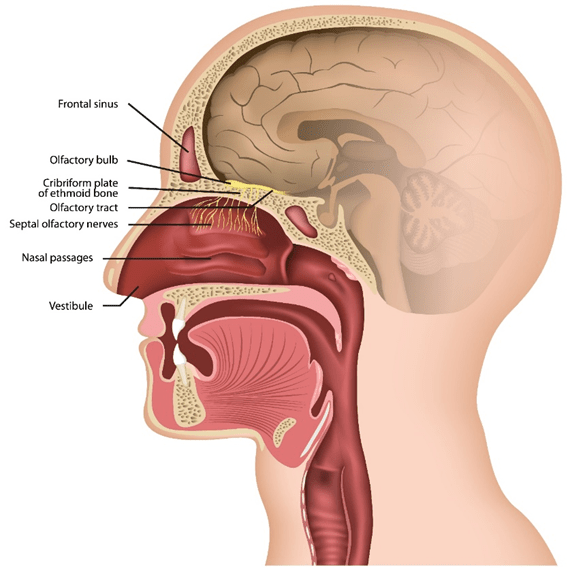
When you smell an odor, you are actually breathing in tiny molecules. These molecules enter the nose through the nostrils and reach the nasal cavity. This part of the nose is lined with small hairs that clean and filter the incoming air. It is lined with a mucus membrane that keeps the nose moist.
The filtered air reaches specialized nerve cells, called olfactory sensory neurons, located high inside the nose. There are a few million of these cells inside your nose. These sensory neurons detect odor molecules and relay signals through the olfactory tract to the olfactory bulb where initial odor processing occurs. The olfactory bulb is a paired structure found on the inferior (bottom) side of both cerebral hemispheres, near the frontal lobe.
Have you ever wondered why a specific smell like spoiled milk, rotten eggs or natural gas elicits such an immediate response? That is one of the programmed systems in your sensory system to alert you to danger. Other scents can stir a pleasant memory of a person or a place. The smell of a campfire at night reminds me of church camp of my youth. Burning candles, especially when they are being extinguished, always reminds me of Christmas Eve celebrations. When I close my eyes, I can see my father shaking the popcorn kettle over the gas stove; the smell of butter, salt and kernels dancing inside. On Sundays, our house smelled of dough, rising on floor registers, in anticipation of my mother layering homemade tomato sauce, pepperoni, mushrooms, mozzarella cheese and green peppers.
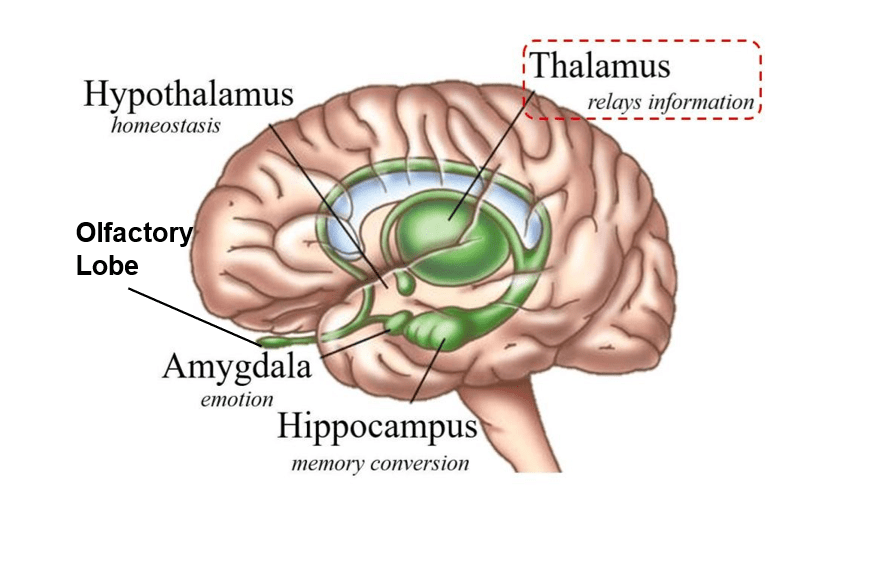
When you see, touch or taste something, that sensory information first heads to the thalamus, which acts as your brain’s relay station. The thalamus then sends that information to the relevant brain areas, including the hippocampus, which is responsible for memory and the amygdala which does the emotional processing. But with smells, it is different. Scents bypass the thalamus and go straight to the brain’s smell center known as the olfactory bulb. The olfactory bulb is directly connected to the amygdala and hippocampus which might explain why the smell of something can so immediately trigger a detailed memory or even intense emotion. Humans have 1000 different types of smell receptors but only four types of light sensors and about four types of receptors for touch. The brain’s smell center connects right to its memory center, and it also stores long-term memories. The memories that come flooding back to you are the result of the way your brain in wired.
During this season of Advent I am reminded of God’s faithfulness throughout history. We serve a God of truth, whose promises are everlasting. When Jesus was born he brought the Kingdom of God to Earth. He lives with us and dwells in us through the Holy Spirit. And some day Jesus will return to restore all Creation. O Come O Come, Emmanuel!
Peace on Earth and good will to all men!
Illustration 142253814 | Anatomy © Medical Stocks | Dreamstime.com
https://www.thereignofthebrain.com/resources/the-limbic-system-thalamus

 Fearfully and Wonderfully Made
Thanks, Peggy. I appreciate your Advent article, as well as the article concerning memory.
As a prayer person with Wellspring, we pray trauma prayers over people, concerning the restoration and healing of the hippocampus and amygdala concerning inner healing of memories.
Have a blessed weekend, Joyce
LikeLike
Thank you Joyce. What a powerful prayer ministry. I need to visit sometime.
LikeLiked by 1 person
Thank you Peggy. I enjoyed reading it.Sending loveAyse
Ayşe İriş Mengüç 859-536-6991aysemenguc1@yahoo.com
LikeLike