God, our father, is relational. God, along with Jesus and the Holy Spirit, comprise the Trinity, three persons in one. As children of God, our Father wants to have a relationship with us. God wants to communicate with us. The Bible is full of stories about God communicating with His children. One way that God the Father communicates with us is through dreams.
In Job 33:14-18, God speaks to Job in dreams and visions of the night. Job’s dreams include warnings, turning people away from wrongdoing, keeping people away from pride and preserving their lives.
14 For God does speak—now one way, now another—
though no one perceives it.
15 In a dream, in a vision of the night,
when deep sleep falls on people
as they slumber in their beds,
16 he may speak in their ears
and terrify them with warnings,
17 to turn them from wrongdoing
and keep them from pride,
18 to preserve them from the pit,
their lives from perishing by the sword.
In Genesis 28: 10-15, God promised Jacob that he would return to the land where he slept, that his descendants would be as numerous as the dust of the Earth, and that He would stay with Jacob wherever he went:
10 Jacob left Beersheba and set out for Harran. 11 When he reached a certain place, he stopped for the night because the sun had set. Taking one of the stones there, he put it under his head and lay down to sleep. 12 He had a dream in which he saw a stairway resting on the earth, with its top reaching to heaven, and the angels of God were ascending and descending on it. 13 There above it stood the Lord, and he said: “I am the Lord, the God of your father Abraham and the God of Isaac. I will give you and your descendants the land on which you are lying. 14 Your descendants will be like the dust of the earth, and you will spread out to the west and to the east, to the north and to the south. All peoples on earth will be blessed through you and your offspring 15 I am with you and will watch over you wherever you go, and I will bring you back to this land. I will not leave you until I have done what I have promised you.”
Job’s dream led to a warning; Jacob’s led to a promise. Another Biblical character, Joseph, had dreams that lead him straight into trouble. His problems began before his dreams, however, due to a rather complicated and dysfunctional relationship with his family:
3 Now Israel loved Joseph more than any of his other sons, because he had been born to him in his old age; and he made an ornate robe for him. 4 When his brothers saw that their father loved him more than any of them, they hated him and could not speak a kind word to him. (Genesis 37:3-4)
As a young man, Joseph had two dreams that foreshadowed his future within this tangled family dynamic. In the first dream, Joseph and his brothers were gathering sheaths of grain in a field, with Joseph’s sheath standing tall and while his brothers’ sheaths bow down to it.
5 Joseph had a dream, and when he told it to his brothers, they hated him all the more. 6 He said to them, “Listen to this dream I had: 7 We were binding sheaves of grain out in the field when suddenly my sheaf rose and stood upright, while your sheaves gathered around mine and bowed down to it.”
8 His brothers said to him, “Do you intend to reign over us? Will you actually rule us?” And they hated him all the more because of his dream and what he had said. (Genesis 37:5-8)
In Joseph’s second dream, he sees his father and mother as the sun and moon, and his eleven brothers as stars, all bowing down to him:
9 Then he had another dream, and he told it to his brothers. “Listen,” he said, “I had another dream, and this time the sun and moon and eleven stars were bowing down to me.”
10 When he told his father as well as his brothers, his father rebuked him and said, “What is this dream you had? Will your mother and I and your brothers actually come and bow down to the ground before you?” (Genesis 37:9-10)
Already having plenty of reasons to despise Joseph, after they heard the two dreams the jealous brothers originally planned to murder Joseph. However, on the advice of the one brother who pitied Joseph, they shifted their plans and sold him for twenty shekels of silver to the Ishmaelites, who took Joseph to Egypt. Potiphar, an Egyptian who was one of Pharaoh’s officials and the captain of the guard, bought him from the Ishmaelites. God blessed and protected Joseph, and eventually, he became governor of the land. When the land of Canaan suffered under a famine, people came to Egypt to buy grain because Joseph had organized the storing of grain in advance to feed the starving people.
Genesis 42: 1-6, records how the dreams that Joseph had as a young man were fulfilled:
1When Jacob learned that there was grain in Egypt, he said to his sons, “Why do you just keep looking at each other?” 2 He continued, “I have heard that there is grain in Egypt. Go down there and buy some for us, so that we may live and not die.”
3 Then ten of Joseph’s brothers went down to buy grain from Egypt. 4 But Jacob did not send Benjamin, Joseph’s brother, with the others, because he was afraid that harm might come to him. 5 So Israel’s sons were among those who went to buy grain, for there was famine in the land of Canaan also.
6 Now Joseph was the governor of the land, the person who sold grain to all its people. So when Joseph’s brothers arrived, they bowed down to him with their faces to the ground.
The summary above is just a snapshot of the third example of a of dream recorded in the Bible. I urge you to continue reading to the end of Genesis chapter 50, with the death of Joseph. One of my favorite Scripture passages about forgiveness and restoration within a family is recorded in Genesis 50:15 – 21.
15 When Joseph’s brothers saw that their father was dead, they said, “What if Joseph holds a grudge against us and pays us back for all the wrongs we did to him?” 16 So they sent word to Joseph, saying, “Your father left these instructions before he died: 17 ‘This is what you are to say to Joseph: I ask you to forgive your brothers the sins and the wrongs they committed in treating you so badly.’ Now please forgive the sins of the servants of the God of your father.” When their message came to him, Joseph wept.
18 His brothers then came and threw themselves down before him. “We are your slaves,” they said.
19 But Joseph said to them, “Don’t be afraid. Am I in the place of God? 20 You intended to harm me, but God intended it for good to accomplish what is now being done, the saving of many lives. 21 So then, don’t be afraid. I will provide for you and your children.” And he reassured them and spoke kindly to them.
Now that we’ve seen some powerful examples of dreams in the Bible, you may be wondering what a dream is exactly anyway.
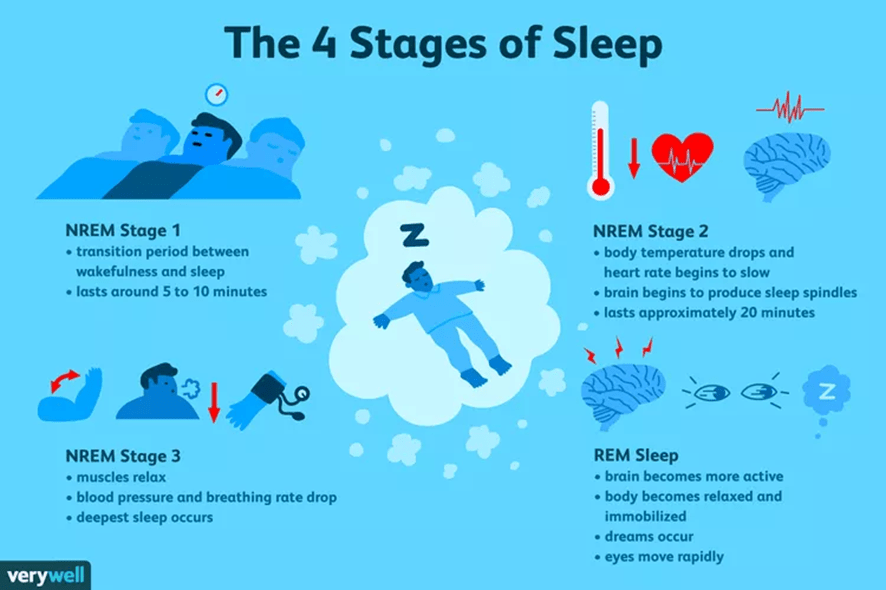
A dream is defined as a series of thoughts, images, or emotions occurring during sleep. Some experts say we dream at least four to six times a night. Dreams can happen anytime during sleep, but they are most likely to occur during REM (rapid eye movement) sleep. REM sleep is the final stage of NREM sleep, and it usually begins about 90 minutes after falling asleep. During REM sleep, the brain is more active, and the eyes dart rapidly under closed lids. These conditions create an ideal environment for intense dreams that can feel realistic. REM periods also tend to get longer as the night progresses, which can make dreams that occur just before waking up feel like full-length experiences.
Sleep cycles vary under different circumstances including age, stress level, food and drink consumption, and medications. The graphic below illustrates a general sleep cycle in humans.
Isn’t it comforting to know that a God who communicates through roaring thunder, perpetual fire, and the parting of oceans would also choose to speak to us through something as seemingly ordinary and commonplace as dreams?
For the next four months, my devotional will focus on different ways that God stays in communication with us.
In the meantime…
Sweet dreams!
https://www.verywellhealth.com/the-four-stages-of-sleep-2795920

 Fearfully and Wonderfully Made