9 Nevertheless, there will be no more gloom for those who were in distress. In the past he humbled the land of Zebulun and the land of Naphtali, but in the future he will honor Galilee of the nations, by the Way of the Sea, beyond the Jordan—
The people walking in darkness
have seen a great light;
on those living in the land of deep darkness
a light has dawned. (Isaiah 9:2, NIV)
It had to have been a dark and scary time for God’s people. The northern regions of the Promised Land, around the Sea of Galilee, the land of Zebulun and the land of Naphtali. were the most severely ravaged by the Assyrian army. Yet it was here, within captivity and darkness, that Isaiah would proclaim the promise that this land will one day receive a special blessing! How beautiful is this promise? Isaiah was declaring that a time was approaching that darkness would soon be illuminated by light.
Matthew 4:13-16 quotes this passage as clearly fulfilled in the Galilean ministry of Jesus. The majority of Jesus’ ministry took place in this northern area of Israel, around the Sea of Galilee.
13 Leaving Nazareth, Jesus went and lived in Capernaum, which was by the lake in the area of Zebulun and Naphtali— 14 to fulfill what was said through the prophet Isaiah:
15 “Land of Zebulun and land of Naphtali,
the Way of the Sea, beyond the Jordan,
Galilee of the Gentiles—
16 the people living in darkness
have seen a great light;
on those living in the land of the shadow of death
a light has dawned.” (Matthew 4:13-16, NIV)
God created light
1 In the beginning God created the heavens and the earth. 2 Now the earth was formless and empty, darkness was over the surface of the deep, and the Spirit of God was hovering over the waters.
3 And God said, “Let there be light,” and there was light. 4 God saw that the light was good, and he separated the light from the darkness. 5 God called the light “day,” and the darkness he called “night.” And there was evening, and there was morning—the first day. (Genesis 1:1-5, NIV)
One of God’s most magnificent creations is the human eye. God created the human eye to detect only a small part of the electromagnetic spectrum – visible light. Wavelengths that are longer and shorter than those within the range of visible light are not detected by the human eye.
Radio waves and infrared waves have wavelengths that are too long to be detected by the human eye. The longer the wavelength, the lower the frequency. Can you imagine what it would be like if humans could see cell phone, TV and radio waves? This would be chaos for sure!
Gamma rays, X-rays and ultraviolet light have wavelengths that are too short to be detected by the human eye. These wavelengths have high frequencies and cause damage to human cells. Applying sunscreen can protect humans from the ultraviolet light from the Sun. X-rays can be used for diagnosis of bone injuries and cavities in teeth. Gamma rays are used in radiation cancer therapy, decreasing the size of tumors.
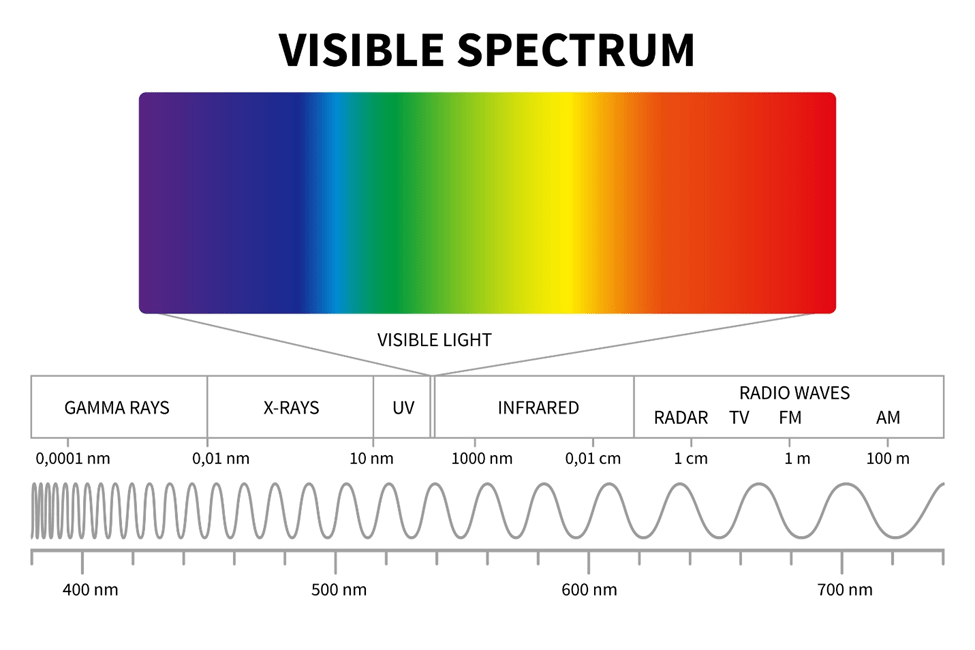
Have you ever wondered why the order of colors in a rainbow are always red, orange, yellow, green blue, indigo and violet? The color red has the longest wavelength and the lowest frequency. The color violet has the shortest wavelength and the highest frequency. Sunlight is white light, which is a mixture of all visible colors. As sunlight passes through the water droplets, it is bent and split into seven colors: red, orange, yellow, green, blue, indigo, and violet.

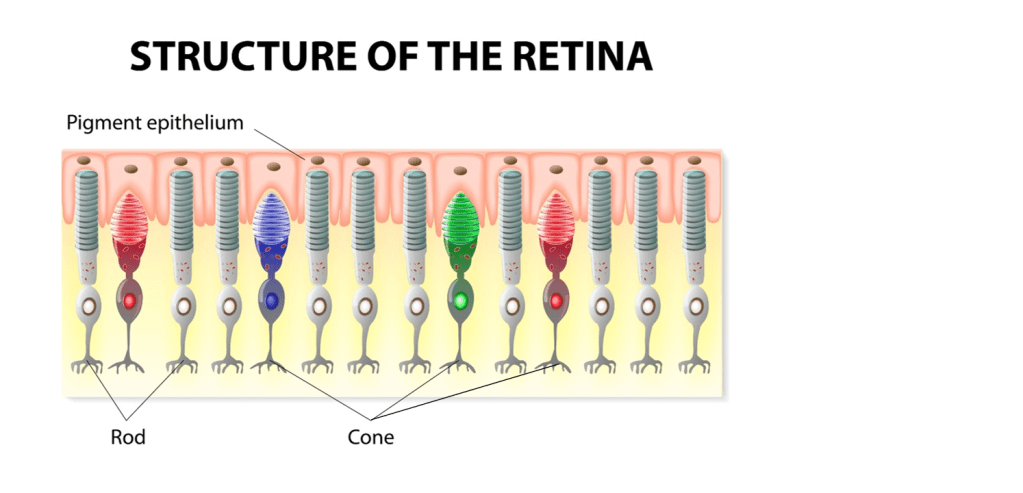
Finally, how does the human eye detect colors? When light interacts with an object, the object absorbs some wavelengths and reflects other wavelengths. Light containing the wavelengths reflected by an object enters the human eye through the cornea and then pupil, an opening in the iris. The cornea and lens focus the light on the retina in the back of the eye. The retina is composed of photoreceptor cells called rods and cones. Rods are sensitive mostly to low levels of light and are not very sensitive to color. However, the cones respond to specific wavelengths of light.
There are three types of cones, red (long wavelength -low energy), green (medium wavelength and energy) and blue (short wavelength, high energy). If the source of the reflected light entering the eye was a blue sofa, then the cones that respond to blue light will send signals to the visual cortex of the brain. The red and green cones will not send signals, so the brain will interpret the color as blue. All of the colors that humans see are the result of the brain receiving signals from three types of cone cells and adding those three colors, (red, green and blue) with the concentration of the amount of signal received by each type of cone cell. For example, the color purple is interpreted by the brain when it receives the combination of signals from both red cones and blue cones.
Isaiah’s prophecy of Jesus 700 years before Christ’s birth is as true today as it was then. Jesus commanded us as His followers to be the light in the darkness before others. May we spread the light of Jesus during this advent season and forever.
14 “You are the light of the world. A town built on a hill cannot be hidden. 15 Neither do people light a lamp and put it under a bowl. Instead they put it on its stand, and it gives light to everyone in the house. 16 In the same way, let your light shine before others, that they may see your good deeds and glorify your Father in heaven. (Matthew 5:14-16, NIV)
8 For you were once darkness, but now you are light in the Lord. Live as children of light (Ephesians 5:8, NIV)
ID 129443009 © Microvone | Dreamstime.com
ID 40412249 | Anatomy © Designua | Dreamstime.com

 Fearfully and Wonderfully Made