Jacob Wrestles With God
22 That night Jacob got up and took his two wives, his two female servants and his eleven sons and crossed the ford of the Jabbok. 23 After he had sent them across the stream, he sent over all his possessions. 24 So Jacob was left alone, and a man wrestled with him till daybreak. 25 When the man saw that he could not overpower him, he touched the socket of Jacob’s hip so that his hip was wrenched as he wrestled with the man. 26 Then the man said, “Let me go, for it is daybreak.”
But Jacob replied, “I will not let you go unless you bless me.”
27 The man asked him, “What is your name?”
“Jacob,” he answered.
28 Then the man said, “Your name will no longer be Jacob, but Israel, because you have struggled with God and with humans and have overcome.”
29 Jacob said, “Please tell me your name.”
But he replied, “Why do you ask my name?” Then he blessed him there.
30 So Jacob called the place Peniel, saying, “It is because I saw God face to face, and yet my life was spared.”
31 The sun rose above him as he passed Peniel, and he was limping because of his hip. 32 Therefore to this day the Israelites do not eat the tendon attached to the socket of the hip, because the socket of Jacob’s hip was touched near the tendon. (Genesis 32:22-32, NIV)
Jacob is considered a patriarch and forefather of the Israelites in Judaism and Christianity. Jacob’s life is seen as an example of struggle, deceit, forgiveness, and God’s faithfulness.
Jacob, the younger twin born to Isaac and Rebekah, was a trickster. First, he tricked his older brother Esau into selling his birthright for a bowl of stew. Then, he proceeded to trick his blind father, Isaac, into giving him the blessing intended for Esau.
Upon discovering the loss of the blessing from his father, Esau was enraged and threatened to kill Jacob. So, Jacob fled to his uncle Laban’s home in Haran. Jacob worked for Laban for seven years to earn the hand of his beloved Rachel, but he had no idea that his Uncle Laban was a trickster, too! Laban tricked Jacob into marrying Rachel’s older sister, Leah, first. He didn’t receive Rachel as his wife until he had worked an additional seven years. He had 12 sons and one daughter through Leah, Rachel, and their handmaidens, who became the founders of the 12 tribes of Israel.
The Scripture passage above describes what happened when Jacob was returning to Canaan. Even after all of Jacob’s deceitful acts, God renamed him Israel, meaning “he who struggles with God.”
Soon after Jacob wrestled with God, he was reconciled with his brother Esau, who forgave Jacob for stealing his blessing twenty years before.
Jacob connected with God, which initiated a healing connection with his brother Esau. Jacob’s twelve sons connected him with what would become an Israelite people blessed by God. As you examine the different joints, including the hip, it becomes clear how God created the different parts of our body to connect and move together.
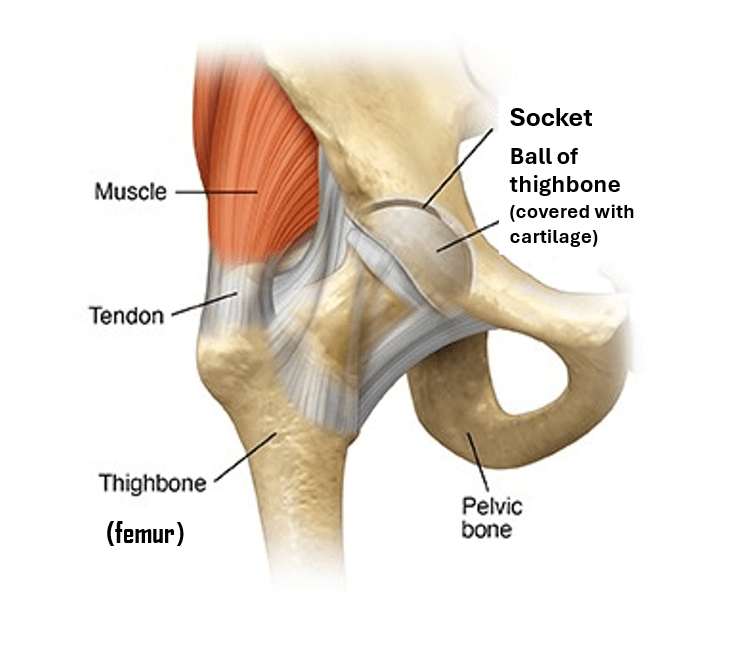
The hip joint is formed where the rounded head of the thighbone (femur) joins the pelvic bone. The joint is covered with tissue and powered by large muscles. When all the parts listed below are healthy, a hip should move easily.
- Cartilage is a layer of smooth tissue. It covers the ball of the thighbone and lines the socket of the pelvic bone. Healthy cartilage absorbs stress and allows the ball to glide easily in the socket.
- Muscles power the hip and leg for movement.
- Tendons attach the muscles to the bones.
The hips, along with the shoulders are classified as ball-and-socket joints. Ball-and-socket joints allow the widest range of movement among the six types of freely moveable joints. These movements include backward, forward, sideways, and rotating. If you have ever watched a ballerina or a gymnast, you have observed all those movements covering three planes. Gliding joints which are located between the vertebrae and the bones in the wrist and ankle also allow movement in three planes, but the movement is highly restricted.
The wrist is a condyloid joint. This joint allows the second greatest range of motion in two planes. The saddle joint also allows movement in two planes. This joint is located in the thumb and allows the thumb to touch the other fingers, which is essential for grasping and manipulating objects. The two remaining examples allow movement in one plane.
The pivot joint is located between the first two cervical vertebrae, atlas (C1) and axis (C2). This joint allows the head to move back and forth and from side to side. A pivot joint is also located near the elbow and near the wrist, allowing rotation movements of the forearm and wrist. The elbow, knee and ankle are examples of hinge joints. They allow bending and straightening movement only.
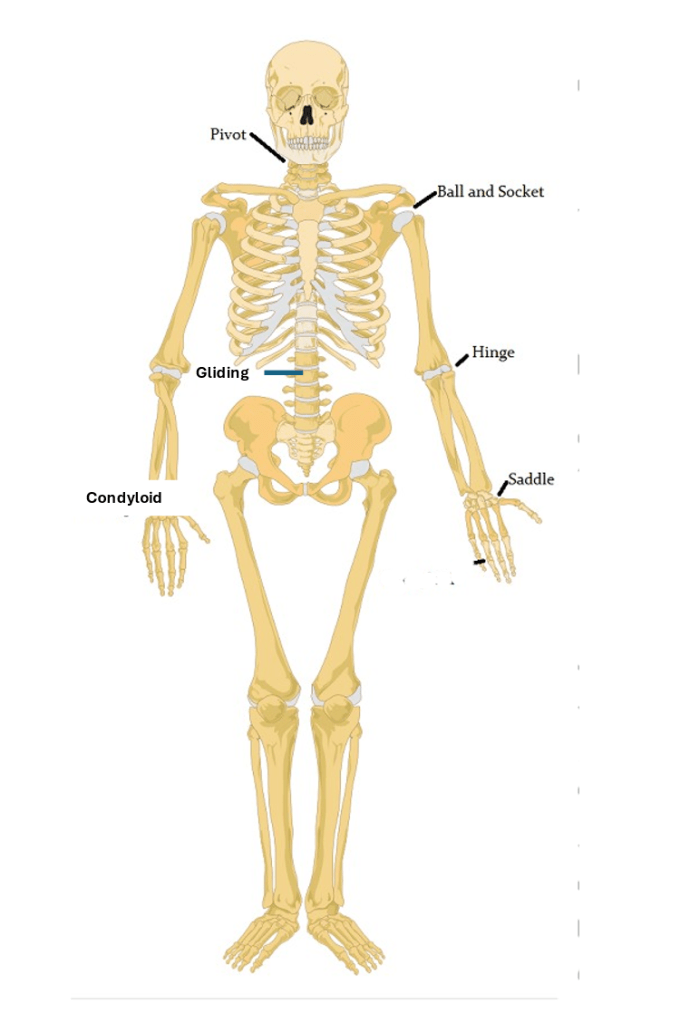
As you look at the picture above, it is so apparent that God not only formed the shape of the bones, but He gave the bones the ability to move precisely as the body needs. God created ligaments to connect bones to bones, and tendons to connect bones to muscles.
Just like every person mentioned in the Bible who was apart from God, Jacob was a fallen, broken, incredibly human character. His personality – like ours – was flawed, and yet he sought the Lord. In his struggle with God, he found peace, forgiveness, and blessing. We are connected to Jacob in our own woundedness, and we are always connected to God. As we seek Him and His forgiveness, He enables us to connect with and bless one another. We become new creations and ambassadors for Christ (2 Cor. 5:17, 20). Praise God for these connections!
17 Therefore, if anyone is in Christ, the new creation has come: The old has gone, the new is here! 20 We are therefore Christ’s ambassadors, as though God were making his appeal through us. We implore you on Christ’s behalf: Be reconciled to God.
https://www.saintlukeskc.org/health-library/how-your-hip-works
https://study.com/academy/lesson/the-six-types-of-synovial-joints-examples-definition.html

 Fearfully and Wonderfully Made