Genesis 17:7
7 I will establish my covenant as an everlasting covenant between me and you and your descendants after you for the generations to come, to be your God and the God of your descendants after you. (NIV)
God established a covenant with Abraham and his descendants. God promised to be their God and the God of their descendants, signifying generational blessings and the lasting nature of God’s commitment.
Psalm 119:90
90 Your faithfulness continues through all generations;
you established the earth, and it endures. (NIV)
God’s faithfulness is not a quality that vanishes quickly, but a consistent and enduring characteristic that extends across time and generations. His faithfulness is not limited to one time period of one group of people but is a constant throughout history.
Psalm 100:5
5 For the Lord is good and his love endures forever;
his faithfulness continues through all generations. (NIV)
God’s love and His faithfulness are connected. His love endures forever and His faithfulness continues through all generations.
Psalm 103:17
17 But for those who honor the Lord, his love lasts forever,
and his goodness endures for all generations. (GNT)
God’s love and righteousness extends to future generations who follow His commands. Like the previous Psalm, this verse emphasizes the long-lasting impact of God’s faithfulness.
It is certainly a comfort to remember that God’s love and faithfulness extend far beyond our reality, into generations of family members we will never meet. But not only will our descendants carry God’s blessings, they will carry with them the physical traits we pass on. If you look at my two daughters, their skin tone, hair color, and height are direct opposites. Yet each one possesses clear genetic markers of the DNA they inherited from my family and their father’s family. In the scientific world, geneticists use generational charts and pedigrees to diagnose human disorders that occur within families to try to predict their likelihood in future generations.
Cystic fibrosis (CF) is a condition passed down in families that causes damage to the lungs, digestive system, and other organs in the body.
CF affects the cells that make mucus, sweat, and digestive juices. These fluids, also called secretions, are usually thin and slippery to protect the body’s internal tubes and ducts and make them smooth pathways. But in people with CF, a changed gene causes the secretions to become sticky and thick. The secretions plug up pathways, especially in the lungs and pancreas.
CF gets worse over time and needs daily care, but people with CF usually can attend school and work. They often have a better quality of life than people with CF had in previous decades. In the United States, because of newborn screening, cystic fibrosis can be diagnosed within the first month of life, before symptoms develop. But people born before newborn screening became available may not have been diagnosed until the symptoms of CF showed up. Better screening and treatments mean that people with CF now may live into their mid- to late 50s or longer, providing a better quality of life than those who are being diagnosed later in life.
Cystic fibrosis is an autosomal recessive condition. The gene for CF is located on chromosome 7. If a person has the faulty gene on both of their number 7 chromosomes, they are affected by the condition. If a person has the faulty gene on one of their chromosomes 7, they are not affected. They are carriers of the condition and can pass it down to the next generation.
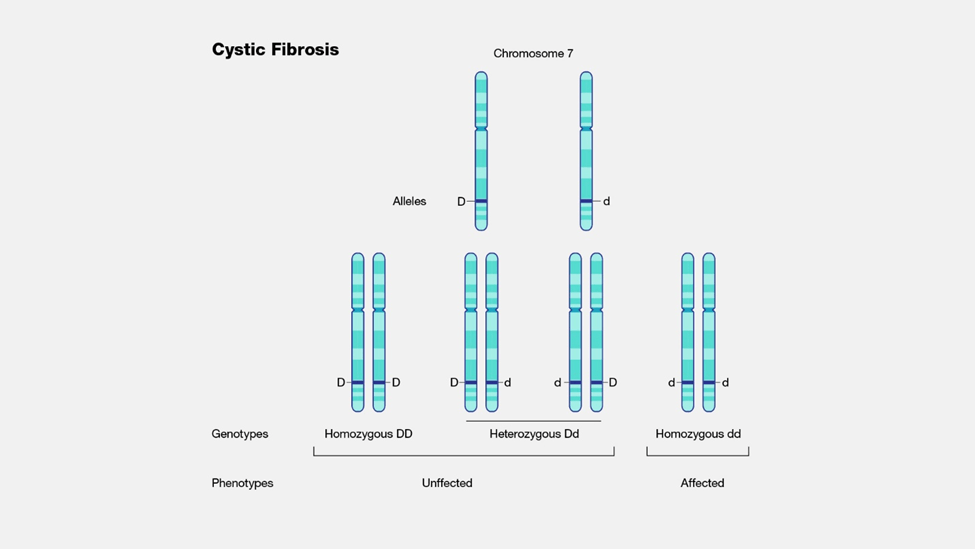
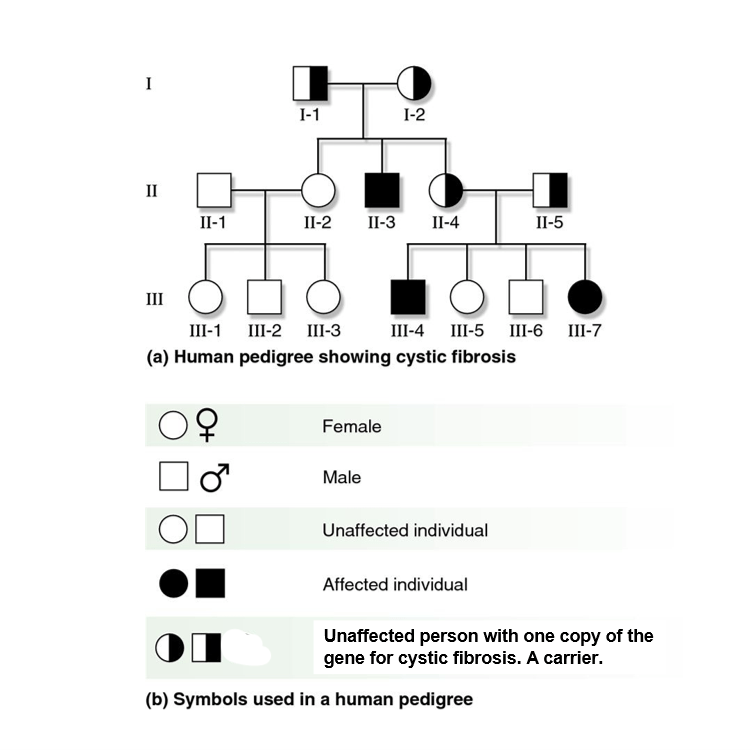
The pedigree above illustrates how the cystic fibrosis condition can be passed down through three generations. Both of the people in generation I are carriers of cystic fibrosis. In this case, every child they conceived had a 25% chance of inheriting the cystic fibrosis condition. They gave birth to three children who are represented in generation II. Their first child was a daughter who did not have a copy of the CF gene on either of his chromosomes 7. She married a man who also did not have a copy of the CF gene. Therefore, they gave birth to three children, represented in generation III, who did not have a copy of the CF gene on their chromosome 7.
The couple’s second child was a son. He received a copy of the CF gene on both of his chromosomes 7; therefore, he was affected by cystic fibrosis. He did not marry.
The couple’s third child was a daughter who was a carrier of cystic fibrosis. She married a man who was also a carrier of cystic fibrosis. They gave birth to four children, represented in generation III. Their first child was a son who inherited a copy of the CF gene on both of his chromosomes 7; therefore, he was affected by cystic fibrosis. Their second child was a daughter who did not inherit the CF gene from either parent. Their third child was a son who also did not inherit the CF gene from either parent. Finally, their fourth child was a daughter who inherited a copy of the CF gene on both of chromosome 7; therefore, she was affected by cystic fibrosis.
From this pedigree, genetic counselors can advise children in generation III of their chances of having a child with cystic fibrosis. You will notice that cystic fibrosis affects both males and females. And because it is a recessive condition, it often skips one generation.
While it can feel frustrating in some ways to have so little control over the genes we inherited and those we pass on, we do have choices when it comes to the kind of spirituality and character traits we offer to those around us. Unlike our DNA, which we inherit passively, the values we reflect to others are an active, intentional decision.
Proverbs 22:6
6 Train up a child in the way he should go;
even when he is old he will not depart from it. (ESV)
Psalm 145:1-7
A psalm of praise. Of David.
I will exalt you, my God the King;
I will praise your name for ever and ever.
2 Every day I will praise you
and extol your name for ever and ever.
3 Great is the Lord and most worthy of praise;
his greatness no one can fathom.
4 One generation commends your works to another;
they tell of your mighty acts.
5 They speak of the glorious splendor of your majesty—
and I will meditate on your wonderful works
6 They tell of the power of your awesome works—
and I will proclaim your great deeds.
7 They celebrate your abundant goodness
and joyfully sing of your righteousness. (NIV)
Deuteronomy 6:6-7
6These commandments that I give you today are to be on your hearts. Impress them on your children. 7Talk about them when you sit at home and when you walk along the road, when you lie down and when you get up. (NIV)
All three of these Scripture passages emphasize the importance of creating a practice of remembering God’s works and reminding younger generations of His faithfulness. Even if our children and grandchildren choose to follow a different path when they reach that point in life where they start deciding things for themselves, they will have this foundation to return to, should they wish. And God, of course, is faithful; He is always able to be found when we seek Him, now and into the thousandth generation.

 Fearfully and Wonderfully Made