12 Therefore, since we have such a hope, we are very bold. 13 We are not like Moses, who would put a veil over his face to prevent the Israelites from seeing the end of what was passing away. 14 But their minds were made dull, for to this day the same veil remains when the old covenant is read. It has not been removed, because only in Christ is it taken away. 15 Even to this day when Moses is read, a veil covers their hearts. 16 But whenever anyone turns to the Lord, the veil is taken away. 17 Now the Lord is the Spirit, and where the Spirit of the Lord is, there is freedom. 18 And we all, who with unveiled faces contemplatethe Lord’s glory, are being transformed into his image with ever-increasing glory, which comes from the Lord, who is the Spirit. (2 Corinthians 3:12-18, NIV)
The Bible emphasizes that the Holy Spirit has a transformative power, changing believers into the likeness of Jesus Christ. In the verses above, Paul reminds the church in Corinth that transformation is an ongoing process, a journey of spiritual growth. As the Holy Spirit goes to work, our minds are renewed, and we begin to produce the fruit of the Spirit in our lives.
When Paul mentions the veil on Moses’s face, he is referencing Exodus 34, which describes how the skin of Moses’s face would shine after meeting with God. Moses’s face so powerfully reflected God’s glory that he covered it with a veil to protect the Israelites from even the reflection of God’s presence with them. Under the old covenant, their sin had caused their minds to be hardened to the point that God’s glory was unbearable to them.
Because of Jesus’s death on the cross, a new covenant was created, and our sins are forgiven. The Holy Spirit can act to remove the veil that once separated us from God. We see Him for who and what He is, and this understanding begins to transform us into His image. This miraculous transformation is never a work of our own will or self-discipline but is only due to the work of the Spirit within us.
The Bible associates the power of the Holy Spirit with the cleansing of sin in several passages. 9 If we confess our sins, he is faithful and just and will forgive us our sins and purify us from all unrighteousness. (1 John 1:9 NIV). 14 How much more, then, will the blood of Christ, who through the eternal Spirit offered himself unblemished to God, cleanse our consciences from acts that lead to death so that we may serve the living God! (Hebrews 9:14, NIV).
In Romans 7, Paul famously writes about the struggle against sin. Despite the presence of the Holy Spirit and his ongoing transformation into the image of God, Paul still finds himself doing the very things he wishes not to do (v. 15 – 20). While in Christ we are no longer slaves to sin, we are still tempted, and the Spirit will often “check” our motives and decisions. Interestingly, the same is true for some of the tiniest components of our bodies: our cells. They have “checkpoints,” too!An average person is estimated to contain roughly 30 trillion human cells, according to recent research.
Each of the 200 different types of cells in the human body has a different weight and size. Within the body, some cells are packed more densely, while others are more spread out.
Cells are constantly dying, and new ones are being made simultaneously. Even though different types of cells die and are replaced at different rates, all new body cells are produced by the same procedure – the cell cycle.
Normal cells move through the cell cycle in a regulated way. They use information about their own internal state and cues from the environment around them to decide whether to proceed with cell division. This regulation makes sure that cells don’t divide under unfavorable conditions. For example, when their DNA is damaged, or when there isn’t room for more cells in a tissue or organ, cancerous tumors, either benign or malignant, are formed.
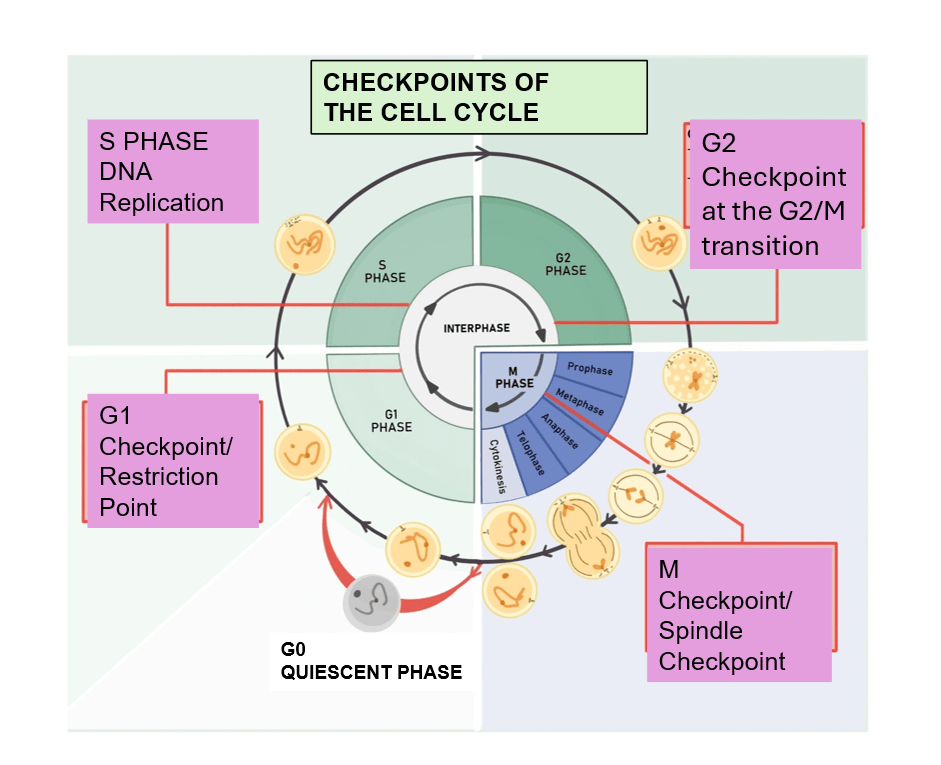
Cell cycle checkpoints
A checkpoint is a stage in the cell cycle at which the cell examines internal and external cues and decides whether or not to move forward with division.
There are several checkpoints, but the three most important ones will be discussed here.
- The G1checkpoint, at the G1/S transition.
At the G1 checkpoint, a cell checks whether internal and external conditions are right for division. Here are some of the factors a cell might assess:
- Size. Is the cell large enough to divide?
- Nutrients. Does the cell have enough energy reserves or available nutrients to divide?
- Molecular signals. Is the cell receiving positive cues (such as growth factors) from neighboring cells? Is there enough room for the addition of new cells?
- DNA damage. Is there any DNA damage?
If a cell does not meet these required criteria, it may leave the cell cycle and enter a resting state called G0phase (Quiescent Phase).Some cells stay permanently in G0phase, while others resume dividing if conditions improve.
- The G2 checkpoint, at the G2/M transition.
- Size: Check for appropriate cell size.
- Proteins: Does the cell have adequate protein reserves?
- DNA integrity. Is any of the DNA damaged?
- DNA replication. Was the DNA completely copied during S phase?
If errors or damage are detected, the cell will pause at this checkpoint to allow for repairs. If the checkpoint mechanisms detect problems with the DNA, the cell cycle is halted, and the cell attempts to either complete DNA replication or repair the damaged DNA.
If the damage is irreparable, the cell may undergo apoptosis or programmed cell death. This self-destruction mechanism ensures that damaged DNA is not passed on to daughter cells and is important in preventing cancer.
- The M checkpoint/Spindle checkpoint at the metaphase/anaphase transition.
- Attachment: Are the chromosomes correctly attached to the spindle fibers? Errors at this point can cause unequal division of the duplicated chromosomes between the two new daughter cells, and they will not be identical to each other or the parent cell.
Isn’t it incredible that God embedded the power to self-monitor within something as minuscule as the cell? He is the God of peace and order, and everything in creation reflects His heart. While we remain imperfect, God continues to send His Holy Spirit to “check,” monitor, and guide us. We can’t accomplish any of this on our own, but “thanks be to God, who delivers [us] through Jesus Christ our Lord!” (Romans 7:25).

 Fearfully and Wonderfully Made