After God delivered the Israelites from Egypt, He instructed the people to remember His words and impress them on their children. In His loving way, God didn’t just issue a command; He also provided different methods to help the Israelites be faithful to His instruction:
4 Hear, O Israel: The Lord our God, the Lord is one. 5 Love the Lord your God with all your heart and with all your soul and with all your might. 6 These commandments that I give you today are to be on your hearts. 7 Impress them on your children. Talk about them when you sit at home and when you walk along the road, when you lie down, and when you get up. 8 Tie them as symbols on your hands and bind them on your foreheads. 9 Write them on the doorframes of your houses and on your gates. (Deut. 6:4-9, ESV)
For something to “be on our hearts,” as is mentioned in verse six, we have to not only understand it but also store it deep within us. We have to transform it from a sensation that happens in that moment into one we can refer to whenever we wish. In other words, we must make it a memory.
Last week, I attended a Bible Quiz Contest at my church. I wanted to see firsthand how the competition was conducted. I wanted to keep a memory of the event and the involvement of the teenagers so that when I prayed for them, my thoughts and words would accurately reflect what happens during a Bible Contest. To say that I was impressed and blessed by what I observed would be an understatement!
After my visit, I wanted to know more. I wanted to know how the teenagers prepared for the competition. I asked the coaches who prepared the teenagers for the competition and below is a list of what they told me.
– Read and reread
– Work on worksheets at home
– Write down the material
– Listen to the material
– Read the material aloud
Each participant usually discovers what works best for them or creates another method that works better for them. They find that the more they can memorize, the more successful they are in the competition. They are impressed with what they can remember when studying using different forms of repetition. Which memorization method works best for you? Have you discovered how memorizing Scripture forms the basis for your thoughts and words?
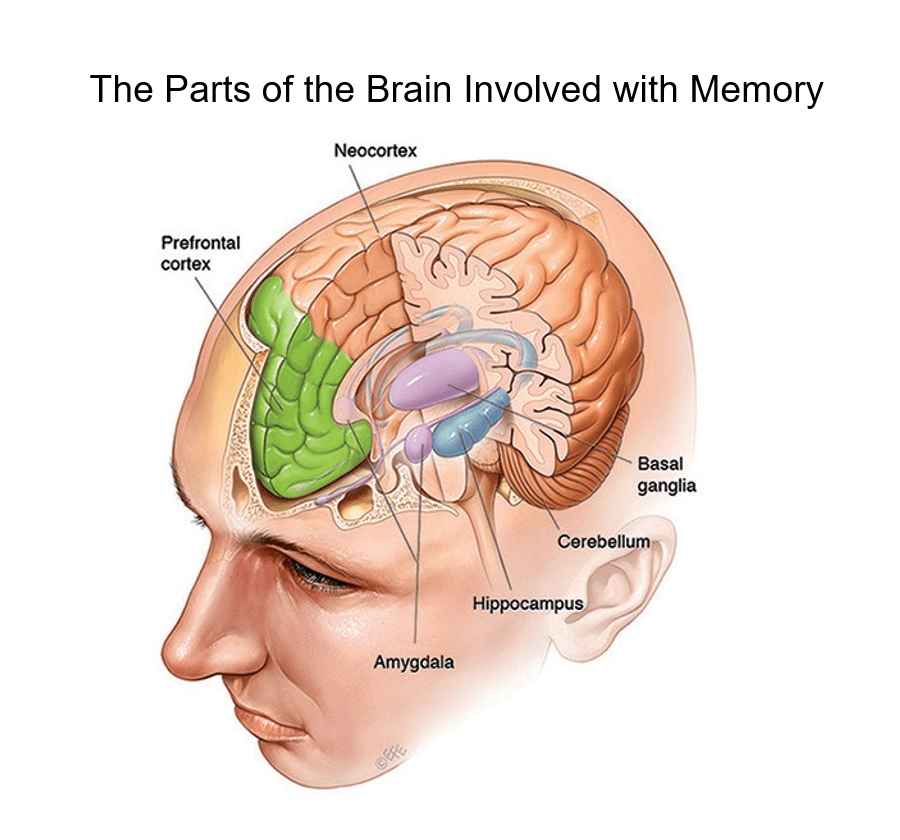
Memories are not stored in just one part of the brain. The different types, long-term and short-term memories are stored across different, interconnected brain regions. Refer to the diagram below to locate each region as it is mentioned in the following discussion.
Long-Term Memories
Long-term memories are divided into two categories: explicit and implicit.
Normally, when we talk about memory or remembering things, we are referring to explicit memory, which is consciously recalled. Explicit memories are further divided into two categories. They can be about events that happened to you; for example, when your friends surprised you with a birthday party. Or they can be about general facts and information, such as your first telephone number or house address when you were a child.
There are three important areas of the brain involved with explicit memories: the hippocampus, the neocortex and the amygdala. Explicit memories are clearly affected by neurodegenerative diseases such as Alzheimer’s disease.
The other kind of long-term memory is implicit, or unconscious memory. These unconscious memories may be a learned procedure involving motor skills. For example, learning how to ride a bike or how to type on a keyboard.
Implicit memories can also result from priming, which occurs when exposure to one stimulus influences your brain’s response to another. Word association is one type of priming. When you hear the word “beach,” you may automatically think of the words “sand” or “ocean.” Implicit memories rely on the basal ganglia and the cerebellum.
Short-term memory
Short-term memory enables the brain to remember a small amount of information for a short period of time. The shortest type of memory is known as working memory, which can last just seconds. This is what we use to hold information in our heads while we engage in other cognitive processes. An example is remembering the numbers a new friend recites as you navigate your phone’s menu system to add a contact. A person’s working memory capability is one of the best predictors of general intelligence, as measured by standard psychological tests.
Short-term working memory relies most heavily on the prefrontal cortex. The prefrontal cortex is an important part of what makes you who you are, and it has a big impact on your daily life. It helps manage thinking, emotions, and behavior by using executive functions. These are skills you rely on to plan, make decisions, solve problems, stay focused, and adjust to new situations.
Traumatic brain injury can damage the prefrontal cortex to various degrees, ranging from a mild concussion to permanent damage from a stroke, vehicle collision, or explosive blasts and other combat injuries. Because God created the brain with the potential of neuroplasticity, what was once thought to be a permanent loss of certain executive functions is no longer true. Neuroplasticity after prefrontal cortex injury allows the brain to reorganize and compensate for damage, often relying on adjacent areas in the prefrontal cortex to take over functions. During rehabilitation, this process involves forming new neural pathways, strengthening connections, and creating new synapses, often resulting in the recovery of lost processing skills.
In John chapter 14, we read how Jesus comforts His disciples. Jesus has told the disciples about His upcoming departure to the Father, and that they cannot come with Him. He promises His disciples that His Father’s house has many rooms and that He is going there to prepare a place for them.
Jesus tells His disciples that He will return and take them to be with Him, and that they will be with Him and know where He is. He tells His disciples to love Him and keep His commands, promising that He will ask the Father to give them an advocate to help them and be with them forever.
Just as brain damage is not always permanent and can be repaired, Jesus offered reparation for His separation with the promise of the Holy Spirit. We are not meant to live hopeless, despairing because we can no longer watch Jesus walk on water or provide food for the multitudes. In ways big and small, seen and unseen, God continues to work within the fabric of our lives. What remains essential is our memory of His work, particularly in those seasons when God appears distant and silent. If His promises remain “on our hearts,” then we can truly trust His words:
25 “All this I have spoken while still with you. 26 But the Advocate, the Holy Spirit, whom the Father will send in my name, will teach you all things and will remind you of everything I have said to you. 27 Peace I leave with you; my peace I give you. I do not give to you as the world gives. Do not let your hearts be troubled and do not be afraid. (John 14:25-27, NIV)

 Fearfully and Wonderfully Made