BLOG November 2020
the body (part two)
16 And if the ear should say, “Because I am not an eye, I do not belong to the body,” it would not for that reason stop being part of the body. 17 If the whole body were an eye, where would the sense of hearing be? If the whole body were an ear, where would the sense of smell be? (1 Corinthians 12: 16-17 NIV)
The Apostle Paul spent the first eighteen months with the believers in Corinth establishing their church community. He made at least two further visits to Corinth. He also wrote letters to the church of Corinth. He saw himself as a kind of father to the Corinthians, constantly affirming his love for them even when corrections and discipline were necessary. In this letter, Paul is addressing disunity in the church brought about by some members claiming to be better than others because of their positions in the church. This caused other church members to feel that they were not useful or needed by the church community.
Paul uses the analogy of parts of the body, where God placed them on the body, their form, and their use. For example the structure, location and purpose of the eye is necessary for the body, but it doesn’t have the same structure, location and purpose of the ear. And the same is true for the ear. Its structure, location and purpose are different from those of the nose. But all three parts are necessary for the body to be whole.
When I was teaching high school human anatomy & physiology, each year my class would visit The Outreach Center for Science and Health Career Opportunities at the University of Kentucky. During one of these visits, I remember being in the classroom with a table lined with different body specimens. The speaker picked up a human brain in his gloved hands and asked, ‘What part of your body sees?” And of course the students answered in unison, “the eye.” Then the speaker asked, “What part of the body hears?” Again, the students answered, “the ear.”
The speaker went on to explain that the eye is perfectly structured to bring an image into the body. But we would never see the image unless it was transferred by the occipital nerve to the region of the brain where sight is processed. And the same is true for the ear. The ear is perfectly structured to bring sound into the body. But sound needs to be transferred by the auditory nerve to the region of the brain that processes sound. And you guessed it! The same is for the nose and the sense of smell! And the tongue and the sense of taste! The speaker held up the brain and declared, “It’s the brain that sees, hears, smells, and tastes!”
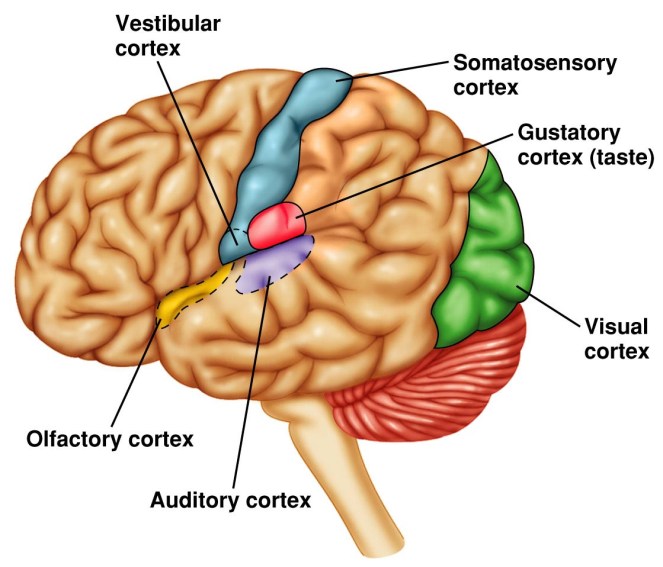
Counterclockwise: Smell, Hearing, Sight, Taste
It’s no accident that all these sense organs are positioned on the head. What if the eye, ear, nose and tongue were located on the hand? Or the foot? Not only would the body look really different, but their individual roles of capturing images, sound, odors, and tastes and transferring them to the brain would certainly be a challenge!
Do you ever find yourself where you do not feel as important or as useful as someone else at work, at school, on your sports team or at church? As each organ captures its own perspective stimulus and relays it to the brain, so it is with members of a group. Each member contributes his/her own unique skills and gifts to the whole body. As in the natural body of man, the members should be closely united by the strongest bonds of love; the good of the whole should be the object of all. All Christians are dependent upon one another; each is to expect and receive help from the rest. Let us then seek unity in the body. Remember the words of Apostle Paul in 1 Corinthians 12: 18-20.
18But in fact God has placed the parts in the body, every one of them, just as he wanted them to be. 19If they were all one part, where would the body be? 20As it is, there are many parts, but one body.

 Fearfully and Wonderfully Made
Awesome! Thank you for another great post PeggyHugs and BlessingsAyşe
LikeLiked by 1 person
I’m so grateful for the unique skills and gifts you contribute to the body, Peggy. You made this scripture come alive!
LikeLike
Thank you Judy!! Love our Monday morning Body of Christian women!
LikeLike
I love the way you pull everything together. Beautiful.
LikeLike
Thank you Moo.
LikeLike