Faith is a muscle. Jesus called his disciples to follow him.
Jesus Calls His First Disciples
18 As Jesus was walking beside the Sea of Galilee, he saw two brothers, Simon called Peter and his brother Andrew. They were casting a net into the lake, for they were fishermen. 19 “Come, follow me,” Jesus said, “and I will send you out to fish for people.” 20 At once they left their nets and followed him. (Matthew 4:18-20, NIV)
Walking with Jesus builds your faith; builds your muscle, so when you need faith, it will be there. Read the Scripture passage below. How did serving with Jesus grow the muscle of faith in his disciples?
Jesus Feeds the Five Thousand
13 When Jesus heard what had happened, he withdrew by boat privately to a solitary place. Hearing of this, the crowds followed him on foot from the towns. 14 When Jesus landed and saw a large crowd, he had compassion on them and healed their sick.
15 As evening approached, the disciples came to him and said, “This is a remote place, and it’s already getting late. Send the crowds away, so they can go to the villages and buy themselves some food.”
16 Jesus replied, “They do not need to go away. You give them something to eat.”
17 “We have here only five loaves of bread and two fish,” they answered.
18 “Bring them here to me,” he said. 19 And he directed the people to sit down on the grass. Taking the five loaves and the two fish and looking up to heaven, he gave thanks and broke the loaves. Then he gave them to the disciples, and the disciples gave them to the people. 20 They all ate and were satisfied, and the disciples picked up twelve basketfuls of broken pieces that were left over. 21 The number of those who ate was about five thousand men, besides women and children. (Matthew 14:13-21, NIV)
Meeting with fellow Christians builds the muscle of faith. Read the Scripture below. How did the early 1st century believers build their muscle of faith?
The Fellowship of the Believers
42 They devoted themselves to the apostles’ teaching and to fellowship, to the breaking of bread and to prayer. 43 Everyone was filled with awe at the many wonders and signs performed by the apostles. 44 All the believers were together and had everything in common. 45 They sold property and possessions to give to anyone who had need. 46 Every day they continued to meet together in the temple courts. They broke bread in their homes and ate together with glad and sincere hearts, 47 praising God and enjoying the favor of all the people. And the Lord added to their number daily those who were being saved. (Acts 2:42-47, NIV)
Have you or someone you know experienced muscle atrophy because of surgery? I remember when my daughter tore the ACL (anterior cruciate ligament) in her right knee during a basketball game. She wore a leg brace and walked on crutches for a week after the surgery. When she removed the leg brace, she and I were surprised at how quickly her right leg had become thinner than her left leg. Her doctor prescribed physical therapy exercises to rebuild the muscle that was lost.
Doctors also prescribe exercises for their patients to perform before the surgery. This is very common for people who undergo scheduled knee or hip replacement surgery. Why is this important? The purpose of these exercises is to strengthen their muscles to lessen the atrophy that will occur during their time of recovery. Depending upon the patient’s age, nutritional health, and type of surgery, inactivity can cause loss of muscle strength at a rate of 12% a week. After 3 to 5 weeks of bed rest, almost 50% of the muscle strength can be lost.
Preventing muscle atrophy following surgery is one of the major concerns of occupational and physical therapy. Muscle atrophy can slow recovery from surgery and lead to longer hospital stays, lower quality of life, and increased chances of readmission to the hospital.
Healthy muscles are able to contract and relax, moving or stabilizing the joints they cross. When atrophy has occurred, the motion that would normally happen at the joint is compromised. This would mean less strength and endurance during the movement, along with potentially less stabilization around the joints crossed. Atrophy can leave our bodies at a higher risk of injury due to lack of neural control of muscles that would normally be responsible for stabilizing and coordinating movement.
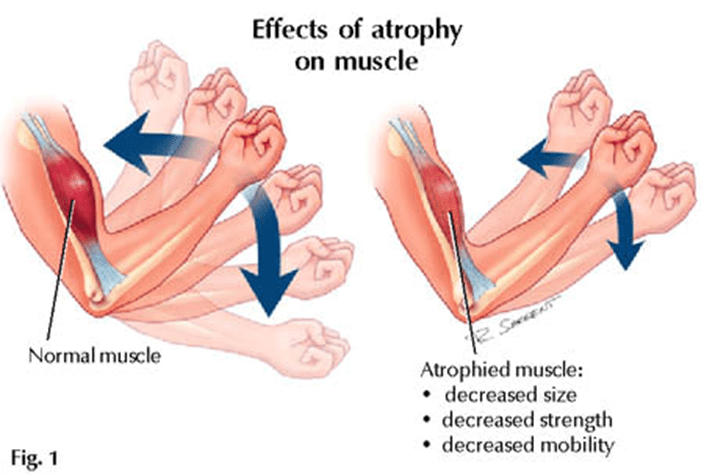
Muscle atrophy is caused by not using the muscles enough. The good news is this type of atrophy can often be reversed with exercise and better nutrition. Muscle is made up of protein, and eating adequate protein after exercising limits muscle protein breakdown and assists with growth of new muscle.
Spiritual atrophy happens slowly as we neglect or underuse our spiritual muscles. The good news is that spiritual atrophy can also be reversed with exercising your faith muscle and feeding on the Word of God! Read the Scriptures, especially the Gospels. Join a small group of believers to share your praises and prayer requests. Study the Scriptures together and pray for each other. Become involved in a personal ministry by serving alongside other believers.
Worship with songs!
Oceans (Where Feet May Fail)
Song by Hillsong UNITED
“Spirit lead me where my trust is without borders
Let me walk upon the waters
Wherever You would call me
Take me deeper than my feet could ever wander
And my faith will be made stronger
In the presence of my Saviour”
https://mend.me/blogs/the-blog/muscle-atrophy-and-how-to-prevent-it

 Fearfully and Wonderfully Made
Thanks for sharing.Mary
Sent from Yahoo Mail on Android
LikeLike
You are welcome!
LikeLiked by 1 person