Jesus held people responsible for reading and knowing the Scriptures. Why was this so? Keep reading, and you will find the answer!
In John 5:1-18, we read that Jesus healed a man who had been an invalid for 38 years at the Pool of Bethesda in Jerusalem. This was a place where many sick people gathered, hoping the stirred waters would heal them. Jesus asked the man if he wanted to get well, and when the man explained his inability to get into the water, Jesus commanded, “Get up, pick up your mat, and walk”. The man was instantly healed, picked up his mat, and walked. Carrying his mat on the Sabbath broke Jewish law, and performing this miracle demonstrated Jesus’ power to heal and His authority over Jewish law.
The Jewish leaders began to persecute Jesus. In His defense, Jesus said that He does the work of His Father, who is always working, thus He, Jesus, is also working. This further aggravated the Jewish leaders because now Jesus was calling God his own Father, making himself equal with God. After defending His authority to heal people on the Sabbath, Jesus speaks of the evidence that supports His claim to be the Messiah.
Testimonies About Jesus
31 “If I testify about myself, my testimony is not true. 32 There is another who testifies in my favor, and I know that his testimony about me is true.
33 “You have sent to John (the Baptist) and he has testified to the truth. 34 Not that I accept human testimony; but I mention it that you may be saved. 35 John was a lamp that burned and gave light, and you chose for a time to enjoy his light.
36 “I have testimony weightier than that of John. For the works that the Father has given me to finish—the very works that I am doing—testify that the Father has sent me. 37 And the Father who sent me has himself testified concerning me. You have never heard his voice nor seen his form, 38 nor does his word dwell in you, for you do not believe the one he sent. 39 You studythe Scriptures diligently because you think that in them you have eternal life. These are the very Scriptures that testify about me, 40 yet you refuse to come to me to have life. (John 5:31-39, NIV)
There it is! There’s the answer to why Jesus holds us responsible to read and know the Scriptures. Because the Scriptures testify about Him! The Jewish leaders missed the point of reading the Scriptures. It was not just an act of obedience fulfilling Jewish laws, but reading the Scriptures to know God’s truth, that Jesus is the Messiah!
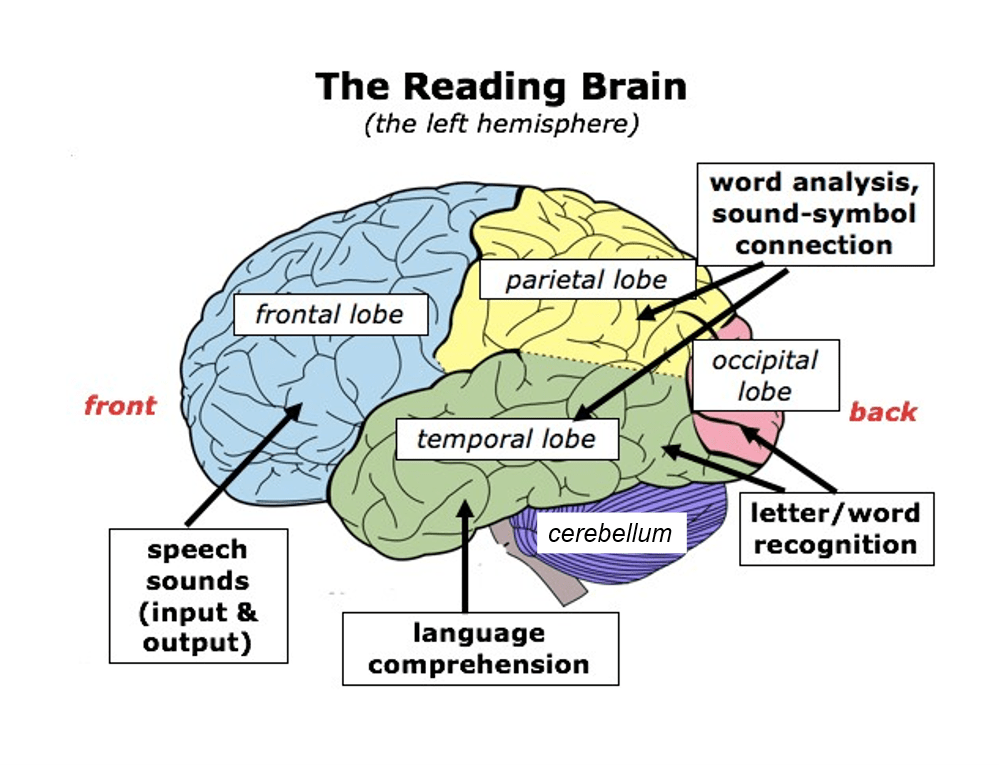
Experienced readers use and integrate several regions of their brain, primarily in the left hemisphere.
- The parietal-temporal region, which does the job of breaking a written word into its sounds (i.e., word analysis, sounding out words).
- The occipital-temporal region where the brain stores the appearance and meaning of words (i.e., letter-word recognition, automaticity, and language comprehension). This is critical for automatic, fluent reading so that a reader can quickly identify words without having to sound each one out.
- The frontal region, which allows a person to speak (i.e., processing speech sounds as we listen and speak).
It is essential to remember that while different regions of the brain can be identified as playing specific roles in the reading process, multiple parts of the brain collaborate during reading. Each major type of information during reading is supported by a network of brain structures rather than localized to a single area; each brain area is responsive to and participates in the processing of multiple types of information.
Every child’s brain has to change the way it functions as the child learns to read. For most students, instruction and practice during the primary grades is sufficient to “train” the regions in the brain to learn to read. Brain imaging research has revealed anatomical and functional changes in typically developing readers as they learn to read. Activation patterns in areas of the brain will be different depending on a student’s reading ability.
For example, beginning readers show more activity in the parietal-temporal (word analysis) region while more experienced readers become increasingly active in the occipital-temporal (word recognition) region. Rich language experiences early in life contribute to making the brain more receptive to the acquisition of reading skills (skills such as phonemic awareness, decoding and word recognition).
Just as learning how to read is a process, so is reading and understanding the Scripture. Reading and studying the Scriptures can bring different insights and meanings. We have been given the gift of the Old Testament – Scriptures prophesying about the coming of Jesus – as well as the New Testament, which is the fulfillment of those prophecies.
FULFILLMENT SCRIPTURE COUPLETS:
14 Therefore the Lord himself will give youa sign: The virginwill conceive and give birth to a son, andwill call him Immanuel. (Isaiah 7:14, NIV)
22 All this took place to fulfill what the Lord had said through the prophet: 23 “The virgin will conceive and give birth to a son, and they will call him Immanuel” (which means “God with us”). (Matthew 1:22-23, NIV)
6 For to us a child is born,
to us a son is given,
and the government will be on his shoulders.
And he will be called
Wonderful Counselor, Mighty God,
Everlasting Father, Prince of Peace.
7 Of the greatness of his government and peace
there will be no end.
He will reign on David’s throne
and over his kingdom,
establishing and upholding it
with justice and righteousness
from that time on and forever.
The zeal of the Lord Almighty
will accomplish this. (Isaiah 9:6-7, NIV)
35 The angel answered, “The Holy Spirit will come on you, and the power of the Most High will overshadow you. So the holy one to be born will be calledthe Son of God. (Luke 1:35, NIV)
https://keystoliteracy.com/blog/how-the-brain-learns-to-read/

 Fearfully and Wonderfully Made
Thanks
Yahoo Mail: Search, Organize, Conquer
LikeLike