Jesus Heals a Man Born Blind
9 As he went along, he saw a man blind from birth. 2 His disciples asked him, “Rabbi, who sinned, this man or his parents, that he was born blind?”
3 “Neither this man nor his parents sinned,” said Jesus, “but this happened so that the works of God might be displayed in him. 4 As long as it is day, we must do the works of him who sent me. Night is coming, when no one can work. 5 While I am in the world, I am the light of the world.”
6 After saying this, he spit on the ground, made some mud with the saliva, and put it on the man’s eyes. 7 “Go,” he told him, “wash in the Pool of Siloam” (this word means “Sent”). So the man went and washed and came home seeing.
8 His neighbors and those who had formerly seen him begging asked, “Isn’t this the same man who used to sit and beg?” 9 Some claimed that he was.
Others said, “No, he only looks like him.”
But he himself insisted, “I am the man.”
10 “How then were your eyes opened?” they asked.
11 He replied, “The man they call Jesus made some mud and put it on my eyes. He told me to go to Siloam and wash. So I went and washed, and then I could see.” (John 9:1-12, NIV)
Having read different commentaries on this passage of Scripture, I am choosing this one to share with you.
Why did Jesus use mud and spit to heal the man’s eyes? He could have said, “Eyes open,” or simply placed his hands on the man’s eyes and they would have opened. When Jesus healed the man who was blind from birth it was on a Saturday, the Sabbath. And there was a crowd of people, including Pharisees, watching the healing.
Working on the Sabbath was illegal, and one of the 39 interpretations of the Pharisees as to what it means not to work on Saturday was you cannot knead dough. Interestingly, the Greek word for “dough”, pēlon, is the identical word for “mud” or “clay.” So just as a woman cannot knead dough on the Sabbath, a brick mason cannot use clay to build a brick wall. So by spitting on the ground and making mud with his saliva, Jesus was breaking the law of not working on the Sabbath.
Why would Jesus choose this method to heal the blind man? Because Jesus is the Lord of the Sabbath. Furthermore, the Father is in Him and He does the work of the Father. 37 “Do not believe me unless I do the works of my Father. 38 But if I do his work, believe in the evidence of the miraculous works I have done, even if you don’t believe me. Then you will know and understand that the Father is in me, and I am in the Father.” (John 10:37-38, NLT)
In last month’s devotional blog we discovered several components and functions of tears. So let us continue learning about another liquid that our body produces, saliva, which also has many components and functions.
Saliva (spit) is a watery liquid your released by your salivary glands into your mouth. Saliva has several functions,
- Keeps your mouth and throat moist and comfortable: Saliva provides a lubricating barrier all over the inside of your mouth, protecting your mucous membranes from injury, bacteria and toxins.
- Aids chewing and swallowing: Saliva moistens your food and turns it into a small ball (bolus) facilitating swallowing and movement down your throat and esophagus to your stomach.
- Starts the digestion process: Saliva contains an amylase, an enzyme that breaks down starches. So when you eat pasta or bread, their digestion begins in your mouth.
- Protects against infection: Saliva contains lysozyme, an enzyme that disintegrates many bacteria and prevents the overgrowth of oral microbial populations in your mouth.
- Protects your teeth: Saliva contains calcium hydroxyapatite, which prevents calcium loss from your teeth. Saliva cleans your teeth by washing away bits of food debris. It also helps dilute acidic foods you chew to protect your teeth from erosion. Overall, it helps reduce your risk of cavities and gum disease.
- Helps maintain the pH balance in your mouth: Saliva helps maintain a pH range of 6.0 to 7.5 within your mouth. Different foods you eat have different pH levels. Saliva helps rebalance your mouth’s pH level after you swallow food.
- Helps repair tissue in your mouth: Saliva has certain proteins and growth factors that work to regenerate tissue and promote wound healing. If you bite the inside of your cheek, for example, your spit can start the healing process.
- Helps you taste food: Dry foods need moisture for your taste buds to pick up on their flavors. Saliva provides this moisture.
Saliva (spit) is produced by your salivary glands. About 0.5 to 1.5 liters (2 to 6.3 cups) of saliva are produced each day in most adults.
You have three major pairs of salivary glands:
- Parotid glands: Located just in front of your ears. The saliva produced by your parotid glands enters your mouth via small ducts near your upper molars. Parotid glands are the largest salivary glands. They are the site of mumps, a viral illness that results in painful swollen parotid glands.
- Sublingual glands: Located below either side of your tongue, under the floor of your mouth.
- Submandibular glands: Located below your jaw. Like your sublingual glands, the saliva from your submandibular glands enters your mouth via small ducts located under your tongue.
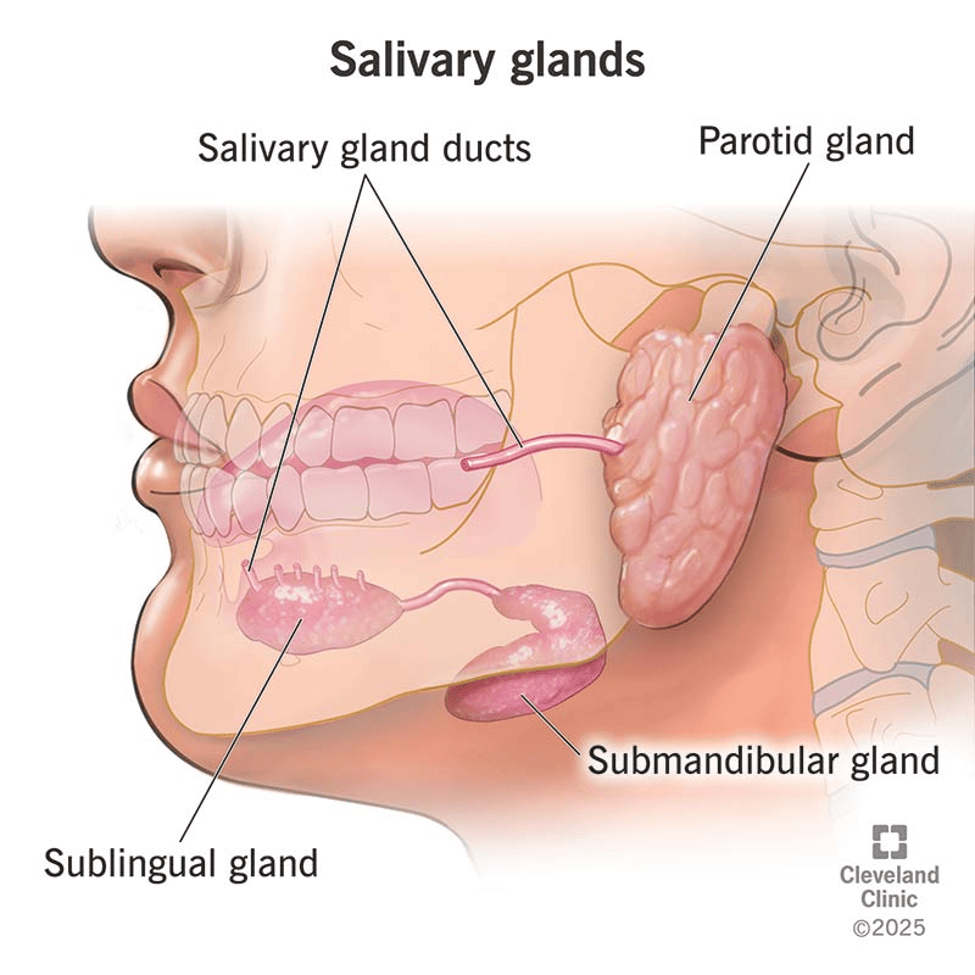
The positions and functions of the three pairs of salivary glands in humans is just one more reminder that you are fearfully and wonderfully made! God designed you in miraculous detail, including the ability to produce saliva to begin the digestion of carbohydrates like bread and pasta! When your parents told you to chew your food, they were right!
https://my.clevelandclinic.org/health/body/saliva
https://www.desiringgod.org/interviews/why-did-jesus-use-spit-and-mud-to-heal


