The Death of Lazarus
11 1-3 A man was sick, Lazarus of Bethany, the town of Mary and her sister Martha. This was the same Mary who massaged the Lord’s feet with aromatic oils and then wiped them with her hair. It was her brother Lazarus who was sick. So the sisters sent word to Jesus, “Master, the one you love so very much is sick.”
4 When Jesus got the message, he said, “This sickness is not fatal. It will become an occasion to show God’s glory by glorifying God’s Son.”
5-7 Jesus loved Martha and her sister and Lazarus, but oddly, when he heard that Lazarus was sick, he stayed on where he was for two more days. After the two days, he said to his disciples, “Let’s go back to Judea.”
8 They said, “Rabbi, you can’t do that. The Jews are out to kill you, and you’re going back?”
9-10 Jesus replied, “Are there not twelve hours of daylight? Anyone who walks in daylight doesn’t stumble because there’s plenty of light from the sun. Walking at night, he might very well stumble because he can’t see where he’s going.”
11 He said these things, and then announced, “Our friend Lazarus has fallen asleep. I’m going to wake him up.”
12-13 The disciples said, “Master, if he’s gone to sleep, he’ll get a good rest and wake up feeling fine.” Jesus was talking about death, while his disciples thought he was talking about taking a nap.
14-15 Then Jesus became explicit: “Lazarus died. And I am glad for your sakes that I wasn’t there. You’re about to be given new grounds for believing. Now let’s go to him.”
16 That’s when Thomas, the one called the Twin, said to his companions, “Come along. We might as well die with him.”
17-20 When Jesus finally got there, he found Lazarus already four days dead. Bethany was near Jerusalem, only a couple of miles away, and many of the Jews were visiting Martha and Mary, sympathizing with them over their brother. Martha heard Jesus was coming and went out to meet him. Mary remained in the house.
21-22 Martha said, “Master, if you’d been here, my brother wouldn’t have died. Even now, I know that whatever you ask God he will give you.”
23 Jesus said, “Your brother will be raised up.”
24 Martha replied, “I know that he will be raised up in the resurrection at the end of time.”
25-26 “You don’t have to wait for the End. I am, right now, Resurrection and Life. The one who believes in me, even though he or she dies, will live. And everyone who lives believing in me does not ultimately die at all. Do you believe this?”
27 “Yes, Master. All along I have believed that you are the Messiah, the Son of God who comes into the world.”
28 After saying this, she went to her sister Mary and whispered in her ear, “The Teacher is here and is asking for you.”
29-32 The moment she heard that, she jumped up and ran out to him. Jesus had not yet entered the town but was still at the place where Martha had met him. When her sympathizing Jewish friends saw Mary run off, they followed her, thinking she was on her way to the tomb to weep there. Mary came to where Jesus was waiting and fell at his feet, saying, “Master, if only you had been here, my brother would not have died.”
33-34 When Jesus saw her sobbing and the Jews with her sobbing, a deep anger welled up within him. He said, “Where did you put him?”
34-35 “Master, come and see,” they said. Now Jesus wept.
36 The Jews said, “Look how deeply he loved him.”
37 Others among them said, “Well, if he loved him so much, why didn’t he do something to keep him from dying? After all, he opened the eyes of a blind man.”
38-39 Then Jesus, the anger again welling up within him, arrived at the tomb. It was a simple cave in the hillside with a slab of stone laid against it. Jesus said, “Remove the stone.”
The sister of the dead man, Martha, said, “Master, by this time there’s a stench. He’s been dead four days!”
40 Jesus looked her in the eye. “Didn’t I tell you that if you believed, you would see the glory of God?”
41-42 Then, to the others, “Go ahead, take away the stone.”
They removed the stone. Jesus raised his eyes to heaven and prayed, “Father, I’m grateful that you have listened to me. I know you always do listen, but on account of this crowd standing here I’ve spoken so that they might believe that you sent me.”
43-44 Then he shouted, “Lazarus, come out!” And he came out, a cadaver, wrapped from head to toe, and with a kerchief over his face.
Jesus told them, “Unwrap him and let him loose.” (John 11: 1-44, The Message)
Eleven years ago a good friend of mine suffered a disabling stroke. Through extensive stroke recovery methods and with the help of her family, she continues to periodically publish on her blog site.
Last spring she wrote a blog entitled, The Gift of Tears. The following is an excerpt from that blog entry.
“If you could only know how I need a good hard cry! It may sound strange, but I have not been able to really cry since my stroke. Today it feels like one of my biggest losses. Tears have always been a part of transformative moments for me, especially when I’m surrendering one thing and taking hold of another by faith. Tears often signify a new beginning.
It’s alarming to me how much humanity fights the act of crying, when it can often bring such release and comfort. Even if nothing changes. However, many of us seek to avoid it at all costs, diverting our attention or shaking it off, as if we really could dry it up. We can gently wipe away a few tears, but heartfelt sobs make us feel inconsolable and out of control. And we like control, don’t we?
Through my walk with Jesus, and desiring to become more like him, I have been driven to acknowledge and understand his emotions. I have desired to possess emotional integrity. I believe some hard knocks in life demand appropriate emotions. I want to be angry, without sin, at the injustices of life, of which there are too many to count. I want to be afraid of harm to myself or others. I want to grieve over real losses. I even want to be appropriately jealous when loved ones have more time and affection for their work, hobbies, and other loves — just like Jesus. But I especially want to weep when Jesus weeps. In John 11 we don’t really know whether Jesus was weeping for the loss of Lazarus or weeping over the sisters who were in deep grief (see Jn. 11:33-35). I think his tears were for both his loss and theirs.
To be like Jesus is to learn how to weep when others weep, even when we know there will be resurrection and redemption. Jesus felt both sorrow and joy simultaneously, and so can we. Both can be true at once and can be felt in the same heart at the same time. It’s a mystery that I don’t have to understand to experience.” 1
Did you know that God created our eyes to produce different types of tears, each with their own purpose? Scientists have divided human tears into three broad categories.
Emotional tears described above as a response to sadness and grief, are also produced in response to joy and happiness, heartbreak and separation, physical pain, empathy and compassion, moral and sentimental feelings like awe beauty, patriotism, and strong sentimental attachments.
Basal tears are in your eyes all the time to lubricate, nourish and protect the cornea (the clear, dome-shaped outer layer at the front of the eye that covers the iris, pupil, and anterior chamber). Basal tears act as a constant shield between the eye and the rest of the world, keeping dirt and debris out of your eye.
Reflex tears are formed harmful irritants, such as smoke, foreign bodies or onion fumes enter your eyes and need to be washed out. Your eyes release reflex tears in larger amounts than basal tears, and they may contain more antibodies to help fight bacteria.
Tears are much more than just water; they contain a powerful mix of natural defenses that protect your eyes from infections, dirt, and damage.
Here are the main protective substances in your tears.
- Lysozyme (The Bacteria Buster): An enzyme that acts like a natural antibiotic. It attacks and dissolves the outer walls of harmful bacteria, destroying them before they can cause an eye infection.
- Antibodies / Immunoglobulins (The Bodyguards): Tiny proteins that recognize and lock onto dangerous viruses and bacteria. They mark them so your immune system can destroy them.
- Lactoferrin (The Starver): Bacteria need iron to grow and multiply. Lactoferrin is a protein that removes all the free iron in your tears, effectively starving the bacteria so they cannot survive.
- Lipocalin (The Shield Specialist): A protein that distributes your tears evenly across your eye. It also removes harmful substances, preventing them from attaching to the surface of your eye.
- Mucins (The Sticky Traps): A gel-like slime layer that covers the eye. It acts like flypaper, trapping dirt, dust, and germs so they can be washed away when you blink.
- Lipids / Oils (The Evaporation Blockers): Made by tiny glands in your eyelids, this oily layer envelopes the very outside of your tear film. It stops your tears from evaporating too fast, keeping your eyes from drying out and getting irritated.
The anatomy of the human eye relevant to tear production is pictured below.
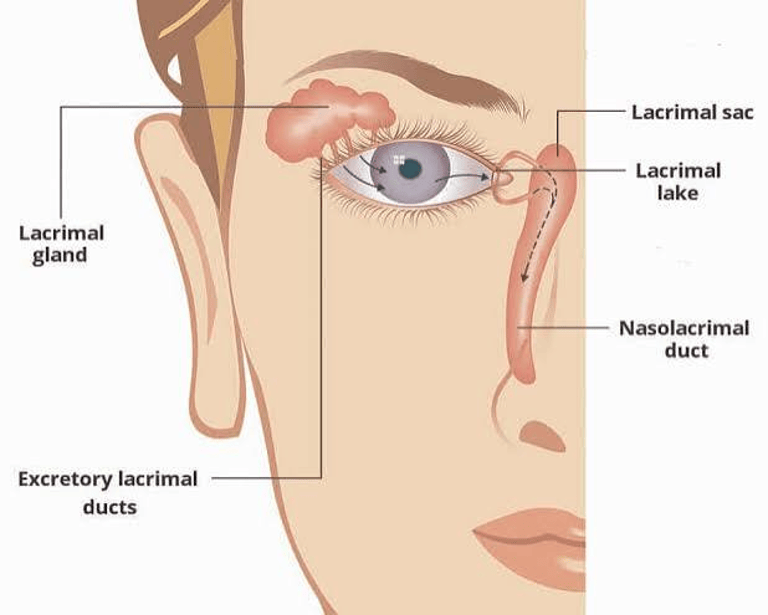
In conclusion, returning to the Scriptural passage above, emotional tears were being shed by Jesus, Mary, Martha and their friends because the man they loved, Lazarus had died. But this is not the end of the story. Jesus resurrected Lazarus eliciting tears of joy and hope!
The family and friends of Lazarus as well as the disciples did not understand why Jesus did not heal Lazarus. Why did Jesus not immediately go to Bethany when he heard that Lazarus was ill? Revisit the Scripture passage above.
John 11: 41-42 – So they took away the stone. Then Jesus looked up and said, “Father, I thank you that you have heard me. I knew that you always hear me, but I said this for the benefit of the people standing here, that they may believe that you sent me.”
Read ahead to verse 45 – Therefore, many of the Jews who had come to visit Mary, and seen what Jesus did, believed in him.
Psalm 30: 4-5, NKJV
4 Sing praise to the Lord, you saints of His,
And give thanks at the remembrance of His holy name.
5 For His anger is but for a moment,
His favor is for life;
Weeping may endure for a night,
But joy comes in the morning.
https://teachmeanatomy.info/head/organs/eye/lacrimal-gland
https://www.aao.org/eye-health/tips-prevention/facts-about-tears
1Journey with Katy at WordPress.com


