6 Do not be anxious about anything, but in every situation, by prayer and petition, with thanksgiving, present your requests to God. 7 And the peace of God, which transcends all understanding, will guard your hearts and your minds in Christ Jesus. (Philippians 4:6–7, NIV)
10 So do not fear, for I am with you;
do not be dismayed, for I am your God.
I will strengthen you and help you;
I will uphold you with my righteous right hand. (Isaiah 41:10, NIV)
8 The Lord himself goes before you and will be with you; he will never leave you nor forsake you. Do not be afraid; do not be discouraged. (Deuteronomy 31:8, NIV)
28 Come to me, all you who are weary and burdened, and I will give you rest. 29 Take my yoke upon you and learn from me, for I am gentle and humble in heart, and you will find rest for your souls. 30 For my yoke is easy and my burden is light. (Matthew 11:28-30, NIV)
There are many situations in life that can cause stress. Have you ever had a situation in your life or in the life of a loved one that just did not make sense? The more you tried to understand what was happening, the more stress you felt.
Have you ever tried to take full responsibility for a situation that was bigger than what you could handle? Did you feel so anxious and stressed because you were attempting to resolve the situation by yourself?
Are you currently in a situation that is causing you a lot of anxiety and stress? Reread the Scriptures above and be encouraged by the promises that each Scripture verse gives you.
Memorize the Scripture verse that speaks to you the most and speak it out loud throughout the day as you start to feel anxious or stressed.
The Bible never promises us a completely stress-free life. You do not have to look far in Scripture to find individuals who felt anxious and afraid. Moses felt stressed when he confronted Pharoah about his mistreating of the Hebrew people (Exodus chapter 5). Later, Moses felt even more stressed when trying to lead the Israelites through the desert! The people of God felt stressed by the giants living in the Promised Land. Joseph felt stress as his brothers sold him into slavery, and then again as he waited years in prison after being falsely accused. David felt stressed when threatened by Saul. (I Samuel chapter 19). And Jesus himself felt so much stress the night before his crucifixion that the Bible tells us He sweated blood (Luke 22: 42-44).
God knew when He created us that we would need a method to manage stress in a fallen world. In His wisdom, He gave our bodies a way to deal with anxiety when it inevitably occurs.
Stress is managed in our bodies by three primary stress hormones: cortisol, adrenaline (epinephrine), and noradrenaline (norepinephrine).
All three hormones are released by the adrenal glands, located on the top of the kidneys to help the body react to physical or mental challenges. Adrenaline and noradrenaline are produced and released into the bloodstream in response to a crisis situation.
Adrenaline (Epinephrine)
- Triggers the fast “fight-or-flight” response.
- Makes the heart beat faster and raises blood pressure.
- Gives a quick boost of energy to face or flee danger.
Noradrenaline (Norepinephrine)
- Works closely with adrenaline.
- Narrows blood vessels to help keep blood pressure high.
- Focuses attention and boosts reaction speed.
Cortisol is produced and released into the blood stream to complement adrenaline and noradrenaline during a crisis situation,
Cortisol
- Often called the main “stress hormone”.
- Controls blood sugar levels and metabolism.
- Slows down non-essential functions like digestion and immune response during a crisis
Even though the hormone cortisol plays a major role in the body’s “fight-or-flight” response, it is an essential hormone that affects almost every organ and tissue in your body. It plays many other important roles, including:
- Regulating how your body uses glucose (sugar) for energy
- Decreasing inflammation
- Regulating blood pressure
- Helping control your sleep-wake cycle
Your body continuously monitors your cortisol levels to maintain steady levels (homeostasis). High or low cortisol levels can be harmful to your health. Below is a diagram listing the symptoms of high or low cortisol levels.
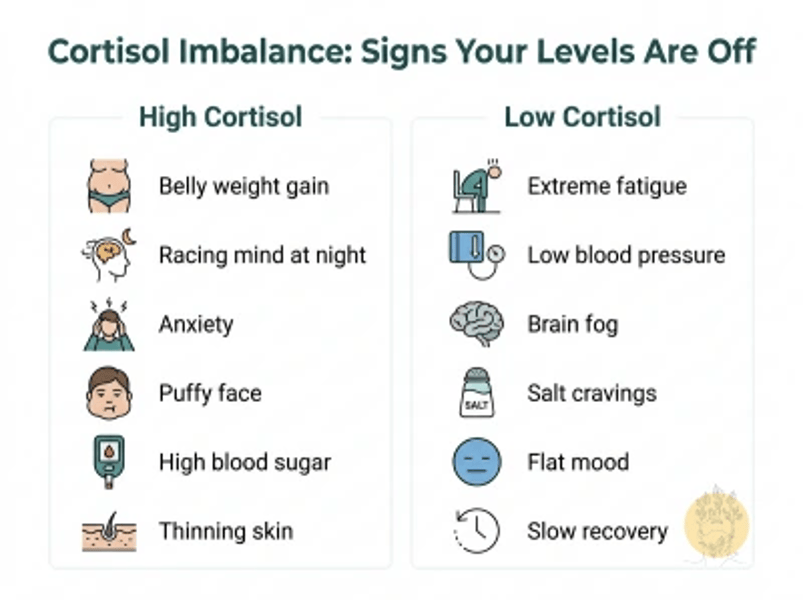
When you are overcome by stress, remember that your body is designed to combat the negative symptoms. Your body has hormones that eliminate these symptoms and bring your body back to normal.
Science shows that deep breathing exercises can help manage stress. Combining breathing exercises with prayer, reciting Scripture, or singing praise songs lowers the level of stress in your body. Meeting with a trusted friend and sharing your burdens is also an excellent way to lower your stress levels.
2 Carry each other’s burdens, and in this way you will fulfill the law of Christ. (Galatians 6:2, NIV)


